


Brightest LED Light Bulbs: Compare Lumens First
How to Identify the Brightest Light Bulb
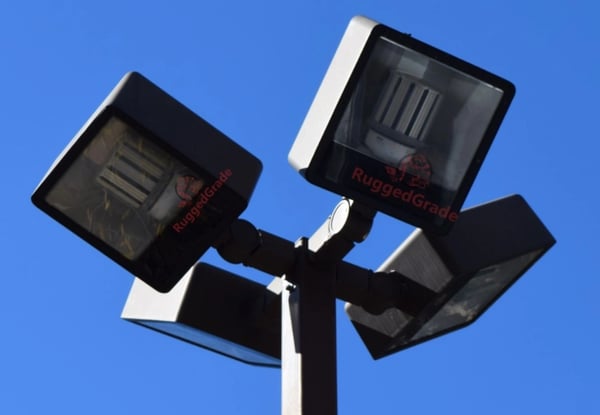
How Are Lumens the Key Measure of Brightness in LED Light Bulbs?
What Are the Brightest LED Bulbs on the Market?
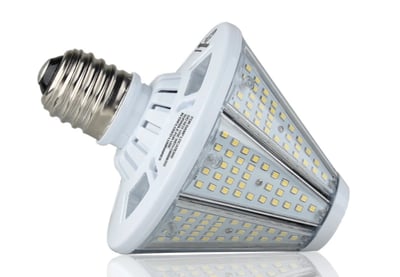
277–480V Corn Light — ARIES IV 450W, 54,000 Lumens
- Up to 54,000 lumens (replaces 1,500W metal halide)
- 277–480V only (high-voltage commercial class)
- E39 large mogul base only
- 3-Kelvin tunable (3000K / 4000K / 5000K — SKU 33-591)
- Typical system efficacy ~120 LPW at 5000K
120–277V Large Corn Light — ARIES IV 270W, 40,500 Lumens
- Up to 40,500 lumens (replaces 1,000W metal halide)
- 120V up to 277V compatible (standard commercial service)
- E39 large mogul base only
- 3-Kelvin tunable (SKU 33-579) or single CCT (SKU 33-572)
- Power-selectable driver taps let you dial wattage down on-site
Residential E26 — ARIES IV A21, 2,800 Lumens
- 2,800 lumens, 360° beam, E26 medium base
- Equivalent to a 200W incandescent at 24W LED draw
- A21 shape fits most household fixtures
- 5,000K daylight or tunable CCT
- 25-year rated life at 3 hours/day
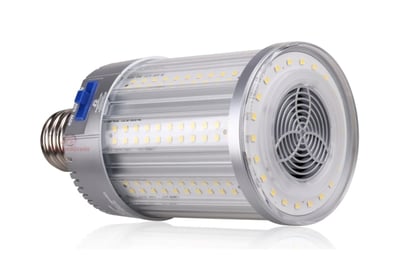
Directional Downlight — PEGASUS II 120W, 17,400 Lumens
- 17,400 lumens (replaces 400W metal halide)
- Connects directly into E39 mogul bases
- Bright white 5,000K color temperature
- 83+ CRI for accurate color rendering
- IEC 60529 IP64 rated for covered outdoor use
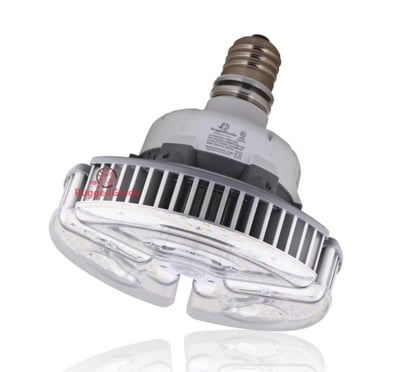
Reversible Post-Top — OBERON II 6,000 Lumens
- 6,000 lumens (replaces 125–175W metal halide)
- Interchangeable E39 and E26 base
- 5,000K cool white color temperature
- Reversible — move the base to top or bottom
- IEC 60529 IP64 for indoor and covered outdoor use
What Are the Factors Influencing Brightness in a Light Bulb?
What to Consider When Buying the Brightest LED Bulbs
- Fixture compatibility. Ensure any bulb you choose is compatible with your existing light fixtures. Check the bulb shape – most household fixtures use A19 or A21, while floodlights use PAR shapes. Also confirm the bulb will fit properly in the space (E39 mogul corn bulbs are physically long and wide; measure the glass enclosure before you order).
- Dimmable capabilities. Many bright LED bulbs can be paired with dimmers to adjust the light brightness. If you want variable control, choose dimmable bulbs and compatible dimmer switches — 0–10V drivers for commercial fixtures, forward/reverse-phase TRIAC for residential.
- Color temperature. LEDs come in different color temperatures, like warm white (3,000K), bright white (4,000K), and daylight (5,000K). Decide which hue you prefer based on ambiance fit and tasks performed in the space — ANSI C78.377 defines the chromaticity bins so a 5000K bulb from one brand matches another on a quality mix.
- Selectable wattages. Some LED bulbs allow you to select different wattages, like 45W equivalent or 60W equivalent. This adjusts the brightness level via a driver tap switch — useful when the fixture ends up brighter than the space needs. Just ensure your fixture is compatible with the top wattage.
- CRI (color rendering index). 80+ CRI is the commercial baseline; 90+ CRI is preferred for retail, museum, and task work where color accuracy matters. Most bright commercial LED bulbs sit at 80–83 CRI, which is fine for warehouse and parking.
- IP rating. For outdoor or damp locations, verify IEC 60529 IP rating. IP64 handles splashing; IP65 handles water jets; IP67 handles temporary immersion. Retrofit bulbs in sealed fixtures are rated to the fixture, not the bulb.
What Is the Lifespan of Bright LED Bulbs?
Brightest Should Mean Useful Lumens, Not Just a Big Number
The brightest LED light bulbs should be compared by delivered lumens, beam angle, socket fit, fixture size, heat management, voltage, and whether the enclosure can handle the lamp. A very high-lumen bulb can perform poorly if it is trapped in a small fixture or aimed into glare.
| High-lumen check | Why it matters |
|---|---|
| Socket and size | Large bulbs may not fit older housings. |
| Heat path | Drivers and heat sinks need airflow. |
| Beam angle | Controls whether brightness reaches the target area. |
More Details to Consider
The brightest LED light bulbs are compared by delivered lumens, not watts. Household A21 retrofits top out around 2,800 lumens, while commercial E39 mogul-base corn bulbs reach well over 40,000 lumens to replace 1,000W to 1,500W metal halide fixtures. The right choice depends on the socket (E26 medium or E39 mogul), the fixture voltage class (120-277V or 277-480V), color temperature, CRI, and IP rating for the location.
A high lumen number alone does not guarantee a good result. Fixture size, heat dissipation, beam pattern, and enclosure rating all determine whether a bulb's rated output actually reaches the task area. A directional 17,400-lumen retrofit can read brighter on target than a higher-lumen omnidirectional bulb because the optics aim the light where it is needed.
For lifespan, look for the L70 hour rating projected under IES TM-21 from LM-80 chip test data. Quality commercial LED bulbs hold about 70% of initial output at 100,000 hours, so the installation stays bright for years rather than fading like metal halide. Match lumens, socket, voltage, CCT, CRI, and IP rating to the application and confirm fixture compatibility before ordering.
Frequently Asked Questions
- How do I identify the brightest light bulb?
- Compare lumens, not watts. Lumens measure the total visible light a bulb emits — higher lumens equals a brighter bulb. Packaging always lists a lumen rating; for a standard household bulb, 450 lumens is dim and 2,600+ is very bright. For commercial spaces, look at 6,000 to 54,000+ lumen LED options depending on the fixture and mounting height.
- Why are lumens the key measure of brightness in LED bulbs?
- Because LEDs are far more efficient than incandescent or fluorescent bulbs. Watts measure energy used, not light output. A 9W LED produces the same 800 lumens as a 60W incandescent — that is 85% less energy for identical brightness. With LEDs, watts only tell you how much power the fixture draws, so lumens are the true brightness comparison.
- What are the brightest LED bulbs on the market?
- For household use the Aries IV A21 at 2,800 lumens is among the brightest standard-base bulbs. For commercial applications, the Aries IV 450W E39 corn bulb reaches 54,000 lumens (replaces 1,500W metal halide), the Aries IV 270W reaches 40,500 lumens (replaces 1,000W MH), the Pegasus II delivers 17,400 lumens (replaces 400W MH), and the Oberon II delivers 6,000 lumens in a reversible post-top or high-bay configuration.
- How long do the brightest LED bulbs last?
- Household LED bulbs are rated 15,000 to 25,000 hours based on 3 hours per day — that is 14 to 23 years in typical use. Commercial-grade LED corn bulbs and retrofits rated to L70 under IES TM-21 often exceed 50,000 to 100,000 hours, meaning maintenance crews touch them once per decade instead of quarterly. Longer life is one of the biggest hidden savings in an LED upgrade.
- What color temperature is best for bright LED bulbs?
- 5000K daylight white delivers the highest perceived brightness for task work, garages, warehouses, and outdoor retrofits — its cool crisp light reveals detail without yellow cast. 4000K neutral white is the usual commercial office and retail choice. 3000K warm white is preferred for living spaces where the goal is ambiance, not maximum visibility. ANSI C78.377 defines the chromaticity bins so a 5000K bulb from one brand matches another on a quality mix.
- Can the brightest LED bulbs go outdoors?
- Yes, but check the IP (ingress protection) rating. The Pegasus II and Oberon II carry an IEC 60529 IP64 rating — sealed against dust and protected from splashing water — which suits covered outdoor fixtures, barn lighting, gas canopies, and post tops. For fully exposed outdoor use, look for IP65 or higher sealed fixtures rather than retrofit bulbs.

Ready to upgrade? Tell us the space and we will size it with you.
Our lighting specialists can help compare options, confirm light levels, and quote the right products for your project.
Call 800-674-9420 or email [email protected]
Monday-Friday, 8am-5pm PST

About the Author
Dara Greaney is founder and CEO of LED Light Expert with deep expertise in commercial LED lighting, retrofits, and photometric planning.
Editing by David Peguero

Trusted by Thousands
Our customers love us — and we love them back.


-
 Free Shipping
On orders over $49.00
-
 Free Extended Warranty
Up to 7 Years Free Warranty On LED Lights
-
100% Satisfaction Guarantee
