

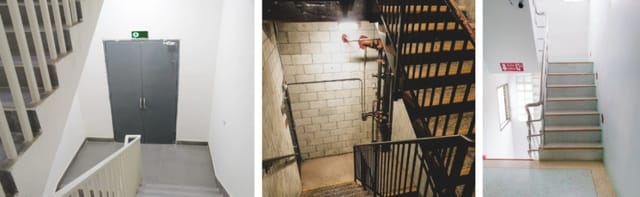
Quick Answer
For most commercial stairwell lighting, 3500K to 4000K is the safest default because it keeps stairs, handrails, landings, and signs easy to see without making the space feel harsh. Use 3000K where hospitality or residential comfort matters. Use 5000K only when the stairwell is security-focused, industrial, or connected to parking and service areas. Always confirm exit-route lighting and emergency-lighting requirements with the local code authority.
Choosing 3000K, 4000K, or 5000K for Commercial Stairwells
Color temperature should serve the stairwell's job. A stairwell is not only a pass-through space. It may be a daily route, an emergency exit, a camera-monitored area, and a place where people need to read signs, see handrails, and notice the edge of each tread.
3000K: Warmer and More Residential
3000K can work in hotels, apartment buildings, restaurants, senior living, and hospitality spaces where the stairwell should feel connected to warmer interior finishes. It may be less visually crisp than cooler light, so verify that the actual light level and contrast are still adequate.
4000K: The Practical Middle
4000K is often the best starting point for office buildings, schools, medical buildings, mixed-use properties, and general commercial stairwells. It gives a clean neutral appearance without the blue-white edge that some occupants dislike.
5000K: Crisp but Easy to Overuse
5000K can help in parking-garage stairs, industrial stairs, security-focused exits, and back-of-house areas. It should be paired with good shielding and fixture placement because color temperature alone does not fix glare, shadows, or poor uniformity.
Compliance Comes Before Preference
OSHA requires exit routes to be adequately lighted so employees with normal vision can see along the route. Exit signs also have illumination requirements. Local building and fire codes may add emergency-lighting and backup-power requirements, so treat Kelvin as a design choice after safety and code needs are covered.
| CCT | Best Use | Watch For |
|---|---|---|
| 3000K | Hospitality and residential-style stairs | Enough contrast on treads and landings |
| 4000K | Most commercial stairwells | Glare and fixture spacing |
| 5000K | Industrial, parking, and security-focused stairs | Harsh appearance and camera glare |
Choosing Color Temperature for Commercial Stairwells
Stairwell lighting has to support safe movement, easy wayfinding, and a sense of security without making the space feel harsh. Color temperature is a major part of that balance. Warm white light can feel comfortable in residential or hospitality stairwells, while neutral white often works well in offices, schools, apartments, and parking structures where visibility and clean appearance matter.
For most commercial stairwells, 3500K to 4000K is a practical range. It gives clearer visibility than very warm light without the cold feel of higher color temperatures. In utility stairs, garages, and industrial buildings, 4000K or 5000K may be appropriate if the space needs a brighter task-oriented look. The final choice should be checked against wall colors, flooring, emergency lighting, signage, cameras, and occupant comfort.
Uniformity, Glare, and Controls
Color temperature alone will not make a stairwell safe. Fixtures should provide even light on treads, landings, handrails, door thresholds, and signage. Avoid bright points at eye level, especially on switchback stairs where people look directly toward fixtures. Diffused lenses, vandal-resistant housings, and careful spacing can reduce glare and shadows.
Controls should preserve safety. Occupancy sensors can reduce energy use, but many stairwells need a minimum standby level rather than full shutoff. Emergency egress requirements, local code, and building policy should guide any dimming strategy. Test the stairwell at night and during daytime transitions so the lighting feels consistent in real use.
- Use neutral CCT for most commercial stairs unless the building design calls for warmer or cooler light.
- Check tread visibility, landings, doors, signs, handrails, cameras, and emergency lighting together.
- Avoid glare from exposed LEDs or fixtures mounted directly in normal sightlines.
- Document CCT, wattage, control settings, and replacement fixture model for maintenance.
Color Temp Stairwell: Buyer and Maintenance Checks
A good decision on stairwell color temperature starts with the real installation conditions, not just the product name. Check the application, mounting height, voltage, light level, glare, controls, wet or dust exposure, service access, and whether a photometric layout or qualified installer is needed before ordering.
| Check | Why it matters |
|---|---|
| Application | Confirms the fixture, lamp, control, or accessory fits the actual space and task. |
| Mounting and wiring | Prevents fit, voltage, access, and safety problems during installation. |
| Controls and maintenance | Protects energy savings, usability, troubleshooting, and long-term performance. |
More Details to Consider
Stairwell lighting has to make treads, landings, handrails, doors, and signage easy to see. Color temperature matters, but uniformity, glare control, emergency requirements, and fixture placement matter just as much.
Warm light can feel more comfortable in hospitality and residential settings. Neutral white is often a good fit for commercial stairs because it balances clarity with comfort. Cooler light may be useful in utility spaces, but it should not create glare at eye level.
If occupancy sensors are used, confirm the stairwell still meets the required standby or emergency light level. Test the space at night and during daylight transitions so the lighting works in real use, not just on a drawing.
Frequently Asked Questions
- What color temperature is best for commercial stairwell lighting?
- Most commercial stairwells work well around 3500K to 4000K because neutral white light balances visibility, comfort, and a professional appearance. Use 3000K for hospitality or residential-style stairs and 5000K only where crisp visibility is more important than warmth.
- Do stairwell codes require a specific Kelvin color?
- Most stairwell and exit-route rules focus on adequate illumination, emergency lighting, visibility, and exit marking rather than a specific color temperature. OSHA requires exit routes to be adequately lighted so employees can see along the route, and local building and fire codes may add more requirements.
- Is 5000K too harsh for stairwells?
- It can be. 5000K can improve crispness in parking garages, industrial stairs, and security-focused areas, but it may feel stark in apartments, hotels, offices, and healthcare buildings. Glare control, fixture placement, and wall reflectance matter as much as Kelvin.
- What should be checked before changing stairwell lights?
- Check existing light levels, emergency backup, fixture spacing, wall color, glare, camera needs, local code requirements, maintenance access, and whether controls will dim the lights during low-traffic periods.


Ready to Upgrade Your LED Lighting?
Our lighting specialists can help compare options, confirm light levels, and quote the right products for your project.
Call 800-674-9420 or email [email protected]
Monday-Friday, 8am-5pm PST

About the Author
Dara Greaney is founder and CEO of LED Light Expert with deep expertise in commercial LED lighting, retrofits, and photometric planning.
Editing by David Peguero

Trusted by Thousands
Our customers love us — and we love them back.


-
 Free Shipping
On orders over $49.00
-
 Free Extended Warranty
Up to 7 Years Free Warranty On LED Lights
-
100% Satisfaction Guarantee
