


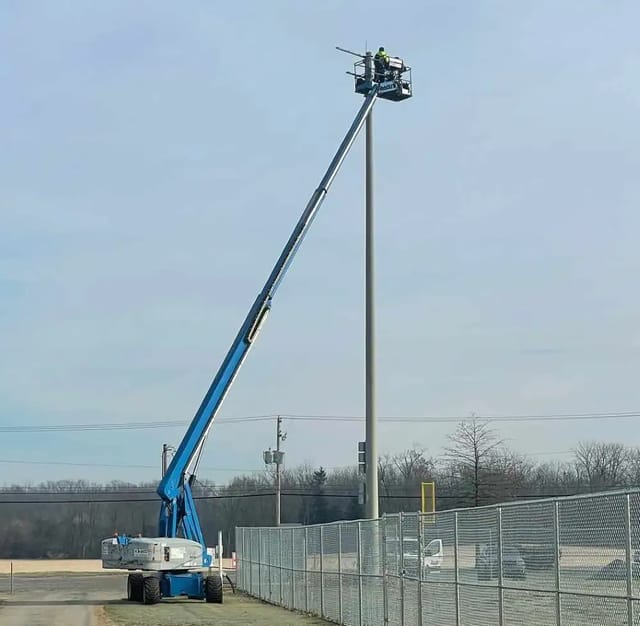
Quick Answer
For stadium light installation or maintenance, use the safest access method that reaches the fixture with room to work: a ladder only for low fixtures, a boom lift or bucket truck for many 15 to 60 foot jobs, and a mobile crane or specialty lift for tall poles, heavy crossarms, or fixture arrays. The choice depends on mounting height, fixture weight, reach, ground conditions, overhead power lines, wind, and whether a qualified operator, rigger, or signal person is required.
What Kind of Crane or Bucket Truck Do I Need for Sports Lighting?
Sports lighting work starts with access. The fixture may be easy to understand, but it is often mounted high enough that maintenance becomes a lift-planning problem. For low wall-mounted flood lights, a properly selected ladder or small lift may be enough. For pole-mounted field lights, bucket trucks, boom lifts, and mobile cranes are common. For tall sports poles, heavy fixture arrays, crossarms, or new pole work, a crane plan may be required.
The decision should not be based on height alone. Fixture weight, side reach, pole location, terrain, soil conditions, wind, overhead power lines, traffic, and whether workers need both hands free all matter. OSHA crane guidance also points to the importance of competent operators, qualified riggers, and qualified signal persons when the work involves hoisting or signaling.
Start With the Height and the Work Type
Fixtures below roughly 15 feet may be reachable with a ladder or small portable lift, but only if the ground is stable and the work can be done without overreaching. For fixtures in the 15 to 60 foot range, a bucket truck or boom lift is often the cleanest option because the worker can inspect, clean, aim, or replace a fixture from a stable platform.
Once the fixture array gets heavier, the pole is difficult to reach, or the work involves lifting a crossarm or new equipment into position, a mobile crane may be safer than trying to solve the job from a bucket. A crane can lift the load while a separate aerial platform gives workers access, but that also increases coordination requirements.
Bucket Truck vs. Boom Lift vs. Crane
A bucket truck is useful when the truck can park close enough to the pole and the boom has the needed working height and side reach. A self-propelled boom lift can work better on fields, tracks, and areas where truck access is limited, but the ground must support the equipment. A crane is for hoisting loads, not simply standing in the air, so it becomes relevant when fixture assemblies, poles, brackets, or heavy components must be lifted.
Ask for equipment charts before scheduling the job. The rated capacity changes with boom angle and reach. A lift that looks tall enough may not be rated for the side reach needed to clear fencing, bleachers, slopes, or landscaping.
Safety Checks Before the Lift
- Confirm the fixture height, fixture weight, and required side reach.
- Inspect ground conditions and outrigging space before equipment arrives.
- Identify overhead power lines and maintain required clearances.
- Check wind limits for the lift, fixture, and pole work.
- Use fall protection, qualified operators, and qualified rigging/signaling where the job requires it.
- Block off pedestrian, vehicle, and player access below the work zone.
High Mast and Stadium Poles
Some high mast poles use lowering systems that bring the luminaire ring down to the ground for service. If that system is present and working, it may eliminate the need for a crane for routine maintenance. Many stadium and sports-field poles do not have lowering systems, so the project may require a bucket truck, boom lift, or crane depending on the pole height and work scope.
For new sports lighting, major retrofits, or tall-pole maintenance, plan the lighting and the access together. A good project considers photometrics, aiming, glare control, surge protection, maintenance access, and the lift plan before the crew is on site.
Crane or Bucket Truck: Start With Access and Reach
Sports lighting installs often need a bucket truck, boom lift, crane, or a combination of equipment. The choice depends on pole height, fixture weight, crossarm layout, reach from safe setup locations, ground conditions, overhead hazards, rigging needs, and whether the crew can work from a stable platform.
| Question | Why it matters |
|---|---|
| How high is the work? | Pole height and aiming location determine lift height and working reach. |
| How heavy is the fixture or assembly? | Weight affects rigging, lift capacity, and whether a crane is required. |
| Can equipment reach the pole safely? | Soft ground, slopes, fences, bleachers, and utilities can change the plan. |
| Who is operating? | Use qualified operators, a lift plan, and site-specific safety procedures. |
More Details to Consider
Sports-light access planning should happen before the crew arrives. Fixture height, side reach, fixture weight, pole location, ground conditions, wind, overhead power lines, and traffic control decide whether a ladder, boom lift, bucket truck, or crane is appropriate.
A bucket truck or boom lift is often enough for inspection, cleaning, aiming, or fixture replacement when it can reach the work safely. A crane becomes relevant when poles, crossarms, or heavy assemblies need to be hoisted.
Use qualified operators, fall protection, rigging and signaling where required, and equipment charts that account for reach and load. The lift plan is part of the lighting project, not an afterthought.
Frequently Asked Questions
- What type of crane or lift is used for stadium lights?
- Many stadium light jobs use a boom lift, bucket truck, or mobile crane. The right equipment depends on fixture height, reach, fixture weight, pole access, ground conditions, wind, and nearby power lines. Low fixtures may not need a crane, while tall poles and heavy crossarms often require a crane plan and qualified lift crew.
- When is a bucket truck enough for sports lighting?
- A bucket truck or boom lift is often enough when the fixture can be reached safely, the platform has enough working height and side reach, and the job is mostly inspection, aiming, cleaning, or fixture replacement. It is not enough when the load must be hoisted separately or the ground, reach, or wind conditions exceed the equipment rating.
- What safety checks matter before lifting stadium lights?
- Confirm ground conditions, overhead power-line clearance, wind limits, fixture weight, rigging points, traffic control, fall protection, and operator qualifications. OSHA crane guidance also makes signal-person and rigger qualifications important when the lift requires signaling or rigging.
- Do high mast light poles always need a crane?
- Not always. Some high mast systems use a lowering device that brings the luminaire ring down for service. If the pole does not have a working lowering system, or if the fixture array is being removed or installed, a crane, bucket truck, or specialty lift may be required.

Ready to Upgrade Your LED Lighting?
Our lighting specialists can help compare options, confirm light levels, and quote the right products for your project.
Call 800-674-9420 or email [email protected]
Monday-Friday, 8am-5pm PST

About the Author
Dara Greaney is founder and CEO of LED Light Expert with deep expertise in commercial LED lighting, retrofits, and photometric planning.
Editing by David Peguero
1 Comments
Bernard Raruoch
What kind of Crane do I need to do the installation of stadium flood light on a tower.
Sales
Thanks for reaching out. Please feel free to reach out to us directly at 888-310-0072 or [email protected] for pricing/quotes or product info at any time.


