


Quick Answer
The best warehouse lighting is the layout that meets the task light level, uniformity, glare, controls, temperature, and maintenance requirements for the actual building. UFO, linear, strip, and low bay fixtures all have a place.
How to Select Warehouse Lighting
Warehouse lighting should be selected around the work: storage, picking, packing, forklift travel, loading, inspection, and maintenance. The fixture style matters, but the layout matters more.
What to Check First
- Mounting height, fixture location, voltage, controls, and service access.
- Target light level, uniformity, glare, spill light, and operating schedule.
- Safety listing, warranty, environmental rating, and current code or program requirements.
- Whether a photometric plan or sample installation is needed before ordering.
Practical Buying Advice
Do not buy by wattage, brightness claims, or product names alone. Compare the fixture data, application, layout, and maintenance plan. For uncertain projects, choose adjustable settings only when the final settings will be locked, labeled, and documented.
Decision Table
| Question | Why It Matters |
|---|---|
| What task is being lit? | The task decides output, optics, controls, and glare limits. |
| What can go wrong? | Heat, glare, poor aiming, wrong listing, or bad controls can erase the benefit. |
| How will it be maintained? | Access, documentation, and replacement parts affect lifetime value. |
Start With the Work Happening in the Warehouse
The best warehouse lighting is not the brightest fixture on a product page. It is the system that supports storage, picking, packing, forklift movement, loading docks, inspections, maintenance, and worker comfort. Large warehouses often have high ceilings and wide aisles, but the most important details are task location, racking height, aisle width, traffic pattern, ceiling height, and operating schedule.
Before choosing fixtures, walk the space and note where people actually work. Small-item picking may need higher task visibility than bulk pallet storage. Loading docks need clear light at trailers and doors. Aisles need uniformity so forklift operators can see floor conditions, labels, rack edges, and pedestrians. Packing and inspection areas may need better color quality and lower glare than open storage zones.
High Bay, Linear, Low Bay, and Retrofit Choices
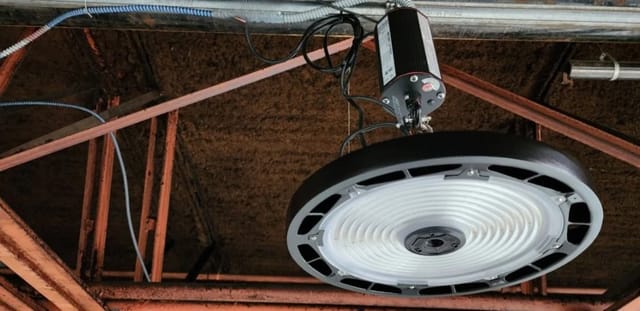
High bay LED warehouse lighting is usually the first option for ceilings above roughly 20 feet. UFO high bays are useful in open spaces, while linear high bays often work well over aisles, production lines, and long rows of shelving. Low bay fixtures can be better for lower ceilings where too much punch from a high bay would create glare or uneven hot spots. Retrofit kits can make sense when the existing housings are sound and the project needs a lower-disruption upgrade.
Do not choose between UFO and linear fixtures by preference alone. Look at the beam spread, mounting height, spacing, fixture orientation, and the work below. A photometric layout can show whether the plan produces enough average light and, just as important, enough minimum light between fixtures and racks.
Efficiency, Controls, and Safety
LED lighting gives warehouses instant-on operation, long life, lower energy use, and compatibility with controls. Occupancy sensors, daylight harvesting, dimming, and scheduling can produce real savings, especially in spaces with intermittent traffic. The controls must be commissioned carefully: lights should not shut off while a worker is still in an aisle, while a forklift is moving, or while a loading operation is underway.
Glare and flicker are common warehouse complaints. Glare can reduce visibility, create eye strain, and make workers less accurate. Flicker can be distracting and, in some environments, can interfere with cameras or moving equipment. Compare fixture data, lensing, driver quality, mounting height, and aisle orientation before assuming all LED high bays will feel the same in use.
Warehouse Lighting Audit Checklist
- Measure ceiling heights, rack heights, aisle widths, and current light levels in active work zones.
- Identify areas with shadows, glare, flicker, dark corners, or maintenance access problems.
- Confirm voltage, mounting method, safety listing, temperature range, dust or moisture exposure, and controls needs.
- Use the audit to decide fixture type, output, spacing, controls, and whether a sample area should be tested first.
Best Warehouse Lighting: Buyer and Maintenance Checks
A good decision on warehouse lighting starts with the real installation conditions, not just the product name. Check the application, mounting height, voltage, light level, glare, controls, wet or dust exposure, service access, and whether a photometric layout or qualified installer is needed before ordering.
| Check | Why it matters |
|---|---|
| Application | Confirms the fixture, lamp, control, or accessory fits the actual space and task. |
| Mounting and wiring | Prevents fit, voltage, access, and safety problems during installation. |
| Controls and maintenance | Protects energy savings, usability, troubleshooting, and long-term performance. |
More Details to Consider
When we talk about warehouses, every inch of space is a battleground for efficiency and safety and the role of lighting goes beyond visibility. The forklifts weave through aisles, the workers select the goods, and the pace doesn't slow throughout the day - and sometimes beyond. In this environment, the right lighting is not just a utility; it keeps productivity flowing. But what does it take to illuminate these huge spaces effectively? The journey to installing the best warehouse lighting begins with looking at the specific needs of your environment.
It's about more than just replacing old bulbs or installing more lights; it's about crafting a lighting strategy that meets the needs of your warehouse activities.
Assessing Warehouse Lighting Needs
Before starting on any lighting project, you need to understand the area you're working with. The vast expanse of a warehouse, with its high ceilings and wide aisles, presents a unique set of challenges and opportunities. The dimensions of the space, ceiling height, and the layout significantly influence the type of lighting solutions best suited for your needs.
For instance, LED warehouse lighting high bay fixtures are often favored for their ability to cover large areas while providing clear, consistent light from above. When you understand the activities that are being performed in different warehouse zones then you are on the right track to implementing effective task lighting. It's not just about ensuring visibility; it's about tailoring the lighting to enhance the performance and safety of workers engaged in varied tasks. Are workers picking small items that require precise lighting? Is the space used for storing large pallets that need broader illumination?
These things will affect the intensity and type of lighting required, ensuring that each area of the warehouse is equipped with the best lighting for productivity and accuracy. Other sections of the warehouse that are used for the storage of large pallets require a different approach to lighting. Here, the goal is broader illumination, to make sure that large items are easily visible and accessible, and that the overall space is uniformly lit to facilitate safe and efficient navigation.
Occupancy patterns - when and where people are within the space - also dictates the lighting strategy. LED Motion Sensor lights, for example, can significantly enhance energy efficiency by illuminating areas only when they are in use. This approach not only reduces energy consumption but also extends the lifespan of lighting fixtures. The most important stage in upgrading your warehouse lighting is conducting a thorough lighting audit. The audit will reveal the current state of your lighting system, identify deficiencies, and spotlight areas for improvement.
It's a crucial step in determining the best lighting for large warehouses, ensuring that any investment made is both effective and efficient. Through a detailed evaluation of your warehouse's lighting needs you can begin to sketch out the blueprint for a brighter, safer, and more productive workspace.
What are the Advantages of LED Warehouse Lighting
Transitioning to LED lighting in warehouse environments is one of the best steps you can take toward making your space more modern.
The benefits of LED warehouse lighting provide advantages that touch upon every aspect of warehouse operations. Now, let's look at the core benefits that make LED lighting the preferred choice for warehouses aiming for efficiency, safety, and sustainability. One of the most compelling arguments for LED lighting being the best lighting for warehouses are the energy savings it offers. LEDs consume significantly less power than traditional lighting solutions, translating into lower electricity bills and a reduced carbon footprint.
For example, the Corvus II Series LED UFO High bay light can perform 21,600 Lumen and has an efficiency of 145lm/watt LEDs. In something as large as a warehouse, the difference can be enormous, with savings that can be redirected towards other essential upgrades or investments. The transition to LED lighting brings companies in line with broader environmental goals, helping warehouses contribute to global efforts to reduce energy consumption and reduce climate change. With lifespans that can extend beyond 100,000 hours, LEDs outdo incandescent bulbs by lasting years, not months.
This longer life span means fewer replacements, reduced maintenance costs, and less downtime - that makes it best lighting for large warehouses. Besides saving the cost of replacements, that same benefit also improves productivity. When you have less down time to replace lights, you can get more done. This too makes your warehouse more sustainable in the long run, and we all want to be more sustainable. Traditional lighting may need time to warm up to full brightness but LEDs provide instant full powered brightness.
This instant-on feature is beneficial in warehouses that operate around the clock or those that use motion sensors to manage lighting efficiently. They cut down on lag time, which makes sure that operations continue smoothly and safely without any waiting period for adequate lighting. Instant-On also paves the way for a safer environment. In an emergency situation, the immediate response of LED lighting can make a crucial difference to the safety of warehouse workers. Safe work spaces are more productive and happier places to work overall.
LED lights have the best light quality around, that helps workers to be more accurate and productive. The bright and clear light minimizes shadows and dark spots, making it easier for employees to get around the warehouse, identify products, and perform tasks with greater precision. LEDs also have different color temperatures and that can be helpful in tailoring the lighting to the needs of different areas within the warehouse, from packing stations to loading docks.
When you transition to LED lighting it's more than an upgrade; it takes your warehouses into the future where efficiency, safety, and sustainability are linked together to improve your daily operations. By choosing the best LED warehouse lighting high bay solutions, warehouses can achieve a brighter, more productive environment that stands the test of time and technology.
Navigating the Challenges of Warehouse Lighting
Lighting a warehouse efficiently goes beyond installing enough lights to brighten the place.
It's about looking at and addressing all the challenges that can impact worker comfort, safety, and productivity. LED technology is lighting the way, offering solutions where traditional lighting systems fall short. Two common problems that happen with warehouse lighting are glare and flicker - they're both capable of reducing visibility and causing eye strain and discomfort for workers. LEDs, with their advanced technology, can be designed to minimize glare and eliminate the flicker associated with fluorescent lighting.
This improvement in light quality can significantly enhance worker comfort and reduce the risk of accidents, making LED lights an essential part of the best lighting for warehouse environments. Another challenge is even lighting across large warehouse spaces. Traditional lighting often results in uneven light distribution, creating shadows and dark spots. Those shadows and dark spots make it unsafe for workers. LED lighting, with its directional capabilities and uniform light distribution, ensures that every corner of the warehouse is adequately lit, from the tallest high bay areas to the darkest corners of the storage aisles.
When you begin to use LED technology you'll find that it holds more than just overcoming challenges. It allows you to use its versatility and efficiency to make a safer and more productive work environment. All you have to do is select the right LED fixtures that align with your warehouse's specific needs.
Selecting the Best LED Warehouse Lights
Choosing the right LED lighting for your warehouse involves considering several key factors that will ensure the chosen solution addresses your space's demands effectively:
First, you have to understand your warehouse's physical layout and operational dynamics. That can include anything from your ceiling height to aisle widths. Understanding these things will help guide you in selecting the appropriate light spread and intensity. Without a clear picture of what you need, you are more likely to spend money unnecessarily for things you don't need, and in worst case scenarios be left redoing the job. So this is perhaps the most important step. As mentioned above, ceiling height is one of the factors you need to look at.
High bay LED fixtures are typically the best choice for large warehouse spaces with high ceilings, offering powerful, even illumination that can cover wide areas effectively. For lower ceilings, low bay LEDs might provide sufficient coverage without overwhelming the space with excessive brightness. LED warehouse lights work for spaces of 1,000 to 1 million sq ft, and heights from 10 to 40 feet. Again ceiling height plays a part in choosing the best mounting option. Suspended, chain, and hook mounts are common for high bay lighting, offering flexibility in positioning and directing light.
You must ensure that the fixtures are accessible for maintenance and any future adjustments. Warehouses have many different areas and the lighting you choose needs to do more than just illuminate things. You can also tailor your lighting to the specific tasks at hand. Areas requiring fine detail work may need higher intensity lights or additional task lighting to ensure precision and reduce errors. Something else to consider is the ergonomics of your workers in the area.
Couple that with the needs of the physical area and you'll be able to come up with the right combination of lighting you need. When choosing LED fixtures you can make sure they save on energy costs by choosing ones that offer control options like dimming, motion sensors, and daylight harvesting. These features can significantly enhance energy savings and adapt the lighting to varying occupancy and daylight conditions. These energy-saving features represent a smart investment in your warehouse's future, offering a substantial reduction in operational costs and a marked improvement in environmental performance.
Selecting the best LED warehouse lighting involves a balance between understanding your space and leveraging the advantages LED technology offers. By addressing the specific challenges of your space and tailoring your lighting solution to meet those needs, you can illuminate your warehouse in a way that promotes safety, efficiency, and productivity.
What Are the Types of LED Warehouse Lighting
Selecting the right type of LED lighting for your warehouse isn't just a matter of preference; it's about finding the perfect match for your specific needs and applications.
Here's a look at the fixtures that stand out in the arena of warehouse lighting: High bay LED lights are vital in the lighting of expansive spaces. They are the stars of the lighting world when it comes to warehouses, manufacturing floors, and any area where ceiling heights soar beyond 20 feet. They are designed for modern lighting technology, and equipped with specialized reflectors and lenses that ensure a broad and even spread of light. This uniform illumination eliminates shadows and dark zones, which is critical for maintaining visibility and safety.
Beyond just being bright, these fixtures top of the class in energy efficiency and longevity, making them a smart investment for businesses aiming to reduce operational costs and environmental impact. The versatility and powerful performance of high bay LEDs render them irreplaceable in a variety of settings, not limited to industrial environments but extending to gyms, large retail spaces, and anywhere high-quality lighting is needed. They contribute to making a safer, more productive workspace, and they enhance visibility for intricate tasks and reduce the risk of accidents.
High bay LED lights transform spaces into safer, more efficient, and sustainable areas of work. Linear LED fixtures bring a combination of elegance and efficiency to warehouse lighting. They are perfectly suited for the specific needs of aisles, workbenches, and assembly zones. They have a streamlined design that not only complements the aesthetics of a space but also casts a wide, even light that can reach into narrow areas, ensuring that every detail is visible. These lights are perfect for tasks requiring precision, they improve visibility, and reduce eye strain.
They have an extreme versatility that extends beyond task lighting and adapts to various applications within warehouses. Whether it's lighting long stretches of aisles for easy navigation or enhancing the functionality of work areas, these fixtures are invaluable assets in creating a safer, more productive workplace. The blend of style, performance, and energy efficiency of linear LED fixtures are key to modernizing warehouse lighting strategies. LED retrofit kits are one of the top choices for warehouses aiming to embrace LED technology without the need for a comprehensive overhaul of existing lighting systems.
These kits are designed to replace fluorescent tubes and other outdated fixtures, enabling a fast and straightforward transition to energy-efficient LED lighting. This upgrade minimizes operational disruptions, allowing daily activities to continue unhindered while allowing the benefits of significant energy savings and enhanced lighting quality. Retrofit kits are a smart, cost-effective solution for warehouses to modernize their lighting, combining the benefits of LED efficiency with the convenience of easy installation.
LED Warehouse Lights
Leading the Way in Energy Efficiency and Sustainability. Every wattage of power counts towards operational costs and environmental impact.
Deciding to embrace energy-efficient lighting solutions is more than just a good practice, it's a game changer for sustainable operations. "By illuminating your spaces with energy-efficient solutions, you not only cast light on your immediate tasks but also lead the way for a brighter, more sustainable future. " -Bill G. General Manager at LED Light Expert. When you select LED fixtures that carry ENERGY STAR certification, UL listing, and DLC (DesignLights Consortium) qualification you are making a wise investment in top notch lighting quality and energy efficiency.
These certifications serve as benchmarks of excellence, indicating that a fixture has met rigorous standards for energy conservation, performance, and safety. By prioritizing these certifications when choosing your lighting solutions, you ensure not only significant energy savings but also the reliability and longevity of your lighting systems. These strict standards help you in making informed decisions that go together with best practices in sustainability. They also make sure that your warehouse is as efficient as it possibly can be.
Many utility companies offer rebates and incentives for adopting energy-saving lighting solutions and by choosing those you can economically transition to LED lighting. Do some thorough research and find what is available for you to apply for. These programs can substantially reduce the upfront costs associated with LED upgrades. This strategy not only bolsters financial efficiency but also underscores the long-term benefits of investing in sustainable, energy-efficient lighting technologies.
The transition to LED warehouse lighting is more than just a shift in technology; it's a strategic choice to move towards enhancing operational efficiency, worker safety, and environmental stewardship. By understanding the types of LED lights available, their applications, and the benefits they bring, warehouses can make informed decisions that light the way to a brighter, more sustainable future. One that operates at the top of the class in regards to worker safety and environmental sustainability. Embracing these innovative lighting solutions is crucial.
Selecting the right fixtures, considering certifications, and leveraging available incentives are steps that not only illuminate our warehouses but also our commitment to a greener planet. When you make smart decisions about your lighting the benefits will last far into the future. When it comes to warehouse operations, where every detail contributes to the bigger picture, choosing the best LED warehouse lighting is critical to weaving together productivity, safety, and sustainability. Make sure you check out all of the LEDs that we have to offer.
Our lighting experts are always waiting to help you through the process and make sure that you make the right choice. We look forward to hearing from you.
Frequently Asked Questions
- What is the best warehouse lighting?
- The best warehouse lighting is the layout that meets the task light level, uniformity, glare, controls, temperature, and maintenance requirements for the actual building. UFO, linear, strip, and low bay fixtures all have a place.
- Are UFO or linear lights better for warehouses?
- UFOs often work well in open areas and high ceilings. Linear fixtures often work better over aisles, production lines, and racking rows. Many warehouses use both.
- How many footcandles does a warehouse need?
- The target depends on storage, picking, packing, inspection, forklift movement, and safety requirements. A photometric plan should confirm average and minimum levels.
- What controls should warehouses consider?
- Occupancy sensors, daylight harvesting, dimming, scheduling, and networked controls can help, but they need commissioning around worker movement and safety.

Ready to Upgrade Your LED Lighting?
Our lighting specialists can help compare options, confirm light levels, and quote the right products for your project.
Call 800-674-9420 or email [email protected]
Monday-Friday, 8am-5pm PST

About the Author
Dara Greaney is founder and CEO of LED Light Expert with deep expertise in commercial LED lighting, retrofits, and photometric planning.
Editing by David Peguero
1 Comments
Devan
Good Afternoon, My name is Devan, I'm a superintendent for a company called JT Thorpe out of Vancouver Washington. Our warehouse is fitted with an old hanging style light that uses a 400w ED37 Mercury Vapor Lamp that puts out 22,600 lumens. We recently had a bulb go out and I'm finding out that those lights/bulbs are no longer allowed for purchase by law in Washington state. I'm told from a local electric/plumbing supply company that I cannot just buy a different bulb type for these fixtures. They say I need to just replace the whole light fixture with an updated light. So, my question is, since they are just large hanging lights that are hooked to a J hook with a chord that uses a 220 plug. Can I just unplug these lights and take them down and hang a newer light using a 220 plug? If so, what light specifically would you suggest? The light would be approximately 20' above the ground floor. We have about 20 of these lights in our warehouse so I would be looking to replace them as the bulbs go out in each one. I look forward to your response. Thank you!
Sales
Thanks for reaching out, we have sent you an email response. Please feel free to reach out to us directly at 800-674-9420 or [email protected] for pricing/quotes or product info at any time


