

Quick Answer
Indoor basketball court lights are usually ceiling- or structure-mounted fixtures focused on glare control, ball visibility, uniformity, and ceiling clearance. Outdoor basketball court lights add weather rating, pole placement, spill-light control, surge protection, aiming, and neighborhood glare. In both cases, use a photometric plan and the current sports-lighting standard rather than sizing by wattage.
Indoor vs. Outdoor Basketball Court LED Lighting
Basketball lighting is not just a brightness purchase. A good system lets players track the ball, judge depth, see the rim, read court markings, and move at speed without fighting shadows or glare. The fixture style, mounting method, beam angle, controls, and environmental rating all change depending on whether the court is inside a gym or outside on poles.
The common mistake is sizing basketball court lights by wattage alone. Wattage tells you how much power a fixture uses; it does not prove the court will have the right average light level, uniformity, vertical visibility, glare control, or spill-light control. The better process is to define the court use, confirm the mounting conditions, then verify the result with a photometric layout.
Why LED Is Usually the Preferred Court Light
LED technology has become the leading choice for basketball courts because it combines high output, instant-on performance, long service life, and better optical control than older metal halide or high-pressure sodium systems. Older fixtures can take minutes to warm up, shift color as they age, and lose usable light long before the lamp fully fails. LED fixtures reach full output immediately and can be dimmed or zoned for practices, games, cleaning, and special events.
- Energy efficiency: Schools, gyms, parks, and community centers often run court lights for hours at a time. Efficient LED fixtures can reduce energy use while maintaining stronger usable light on the playing surface.
- Lower maintenance: Long-life LED fixtures reduce lift rentals, lamp changes, and downtime, which matters most in gyms with high ceilings and outdoor courts with tall poles.
- Better control: LEDs can support dimming, scheduling, occupancy logic, and scene control, so the court does not need the same output for open gym, league play, and cleanup.
- Improved visibility: Good optics reduce glare and aim more of the light where it belongs: on the court, rim, sidelines, and key player sightlines.
Indoor Courts
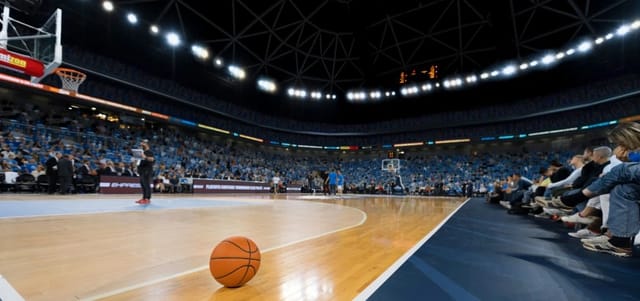
Indoor basketball courts usually use high bays, linear sports fixtures, or purpose-built sports lighting mounted to the ceiling or building structure. The key issues are ceiling clearance, glare, ball tracking, uniformity, color quality, flicker, and how the lights look from player, spectator, and camera angles. In a low-ceiling gym, fixtures may need wider distribution and stronger glare control. In a taller fieldhouse or arena, narrower optics and careful spacing may be needed to keep the court even.
Indoor courts also have reflective surfaces that can make a bright fixture feel harsher than its measured light level suggests. Polished floors, white walls, glass backboards, and light-colored bleachers can create contrast problems. A design should look at both horizontal light on the floor and vertical visibility for the ball, players, and backboard area.
Indoor Planning Details
- Ceiling height and fixture placement: Mounting height determines beam angle, spacing, and how many fixtures are needed. Poor spacing can leave shadows near the lane or over-bright strips along the sidelines.
- Glare reduction: Players often look upward for shots, rebounds, and passes. Shielding, lens choice, aiming, and fixture position matter as much as raw lumen output.
- Color quality: A neutral white range, often around 4000K to 5000K depending on the facility, helps court markings, uniforms, skin tones, and the ball read clearly.
- Controls: Dimming and zoning can reduce energy use during practice and still allow stronger output for games or events.
Outdoor Courts
Outdoor basketball court lights add an entirely different set of requirements. Fixtures must handle rain, dust, humidity, heat, cold, wind, insects, UV exposure, and sometimes salt air. They also need to control spill light onto neighbors, roads, windows, and nearby fields. A fixture that looks bright from the ground may still fail if it creates glare at the free-throw line, leaves the corners dim, or sends light above the court where it does no useful work.
Outdoor courts are usually pole-mounted, so pole height and pole location become central design decisions. Taller poles can widen coverage and reduce harsh angles, but they must be engineered for wind and fixture EPA. Shorter poles may be easier to install but can increase glare if the optics are not chosen carefully.
Outdoor Planning Details
- Weather rating: Outdoor fixtures should normally be IP65 or better, with stronger ratings or corrosion-resistant finishes for harsh climates.
- Pole layout: Poles should sit far enough from the playing area to protect players while still giving the optics a clean aiming path.
- Spill and BUG control: Backlight, uplight, and glare ratings help reduce light pollution and neighborhood complaints.
- Surge protection: Outdoor pole lights are more exposed to electrical surges and lightning-related events, so surge protection is a practical reliability requirement.
- Service access: Plan how fixtures will be aimed, cleaned, inspected, and replaced without closing the court for longer than necessary.
Indoor vs. Outdoor Requirements at a Glance
| Decision | Indoor court | Outdoor court |
|---|---|---|
| Mounting | Ceiling, truss, or structure-mounted fixtures with glare control. | Pole-mounted fixtures with engineered aiming and wind-rated supports. |
| Main risk | Glare, uneven floor light, flicker, and poor ball tracking. | Weather exposure, spill light, pole placement, glare, and surge events. |
| Controls | Dimming, zoning, scheduling, and event scenes. | Timers, photocells, motion logic, curfew schedules, and remote controls. |
| Durability | Dust, heat, lens yellowing, and lift access. | IP rating, corrosion resistance, UV exposure, impact risk, and water intrusion. |
Detailed Indoor and Outdoor Requirements
Proper lighting is essential for basketball courts. It goes beyond just helping players see the ball; it directly affects visibility, safety, and overall performance. A well-lit court reduces shadows, prevents glare, and ensures both athletes and spectators can follow the game without strain. Poor lighting can increase the risk of accidents, cause fatigue, and even limit the competitive quality of the match.
Basketball has grown into a fast-paced sport that demands precision and quick reflexes. Lighting must keep up with those demands. Whether it is an indoor gym or an outdoor recreational court, the right basketball court lights create an environment where players can perform at their best.
General Lighting Requirements
Lighting for basketball courts is not just about installing bright fixtures; it should support fair play, visibility, safety, and comfort.
- Uniformity: A properly lit court ensures that all areas are evenly illuminated. If one half of the court is brighter than the other, players can struggle with depth perception, leading to errors and potential safety issues. Uniform lighting eliminates distracting shadows and keeps conditions consistent across the full playing surface.
- Glare control: Bright fixtures without proper shielding can create glare, which is especially problematic for players looking upward to shoot or rebound. Modern basketball court LED lights are designed with optics and diffusers that direct light onto the floor rather than into players' or spectators' eyes. This reduces strain and improves visibility for everyone in the facility.
- Color rendering: The ability to accurately see colors matters more than many realize. A high Color Rendering Index, typically 80 or above, is essential for distinguishing between team uniforms, reading court markings, and tracking the ball. LEDs excel here, providing crisp and natural visibility that helps players react faster and referees make accurate calls.
- Consistency: Beyond brightness, basketball LED lights deliver consistent output over time. Unlike older fixtures that can dim unevenly, LEDs maintain reliable performance until they approach the end of their lifespan. This ensures the court always meets the necessary standards for safe and fair play.
Indoor Basketball Court Lighting Requirements
Indoor basketball courts require lighting that balances brightness, clarity, and comfort. Since play happens under a fixed ceiling, fixture placement and beam design become critical for ensuring even coverage.
The height of the ceiling determines how fixtures should be installed. In gyms with low to mid-height ceilings, basketball LED lights are usually recessed or mounted directly overhead to limit shadows. In professional arenas with high ceilings, fixtures are hung or suspended with carefully calculated beam angles to ensure uniform coverage across the entire floor. Poor placement can lead to uneven patches that distract players and disrupt the flow of the game.
Glare is one of the biggest issues in indoor courts. Players looking up to take a shot or track a rebound can be blinded by direct light if fixtures are not properly shielded. Modern basketball court LED lights often include optics or diffusers that reduce glare without sacrificing brightness. This benefits not only athletes but also referees and spectators who need clear visibility throughout the game.
For clarity and natural visibility, a color temperature between 4000K and 5000K is recommended. This range provides a crisp, neutral white light that highlights court markings, uniforms, and the ball without appearing too harsh or too warm. It creates an atmosphere that feels professional and consistent across different levels of play.
Indoor facilities benefit from smart lighting controls. Features like dimming and zoning allow operators to adjust brightness for practices, games, or special events. Smart systems can even automate schedules, saving energy and extending fixture life. For arenas hosting televised games, controls also make it possible to adjust lighting for broadcast requirements.
Outdoor Basketball Court Lighting Requirements
Lighting an outdoor basketball court requires more than just brightness. Fixtures must deliver excellent visibility while surviving constant exposure to the elements. From heavy rain to public-use wear, outdoor systems demand durability as much as performance.
Unlike indoor facilities, outdoor courts face unpredictable conditions. Wind, rain, dust, temperature swings, and even snow or salt exposure can impact fixture performance. Beyond weather, public courts must also consider tampering, impacts, and misuse, making fixture strength and tamper resistance critical. For schools, cities, and community organizations that manage these courts, durability directly affects long-term maintenance costs.
The Ingress Protection rating tells you how resistant a fixture is to dust and water. For outdoor basketball court lights, a rating of IP65 or higher is strongly recommended. IP65 is dust-tight and protected against heavy rain or jets of water. IP66 adds protection against stronger, high-pressure water jets. IP67 and higher ratings are suitable for harsher climates where temporary immersion or heavy storms are likely.
Outdoor basketball LED lights are mounted on poles instead of ceilings. The effectiveness of the system depends on how tall the poles are and where they are positioned. Taller poles can provide wider coverage with fewer fixtures, but angles must be carefully adjusted to avoid glare. Poles are usually installed outside the boundary lines, spaced evenly along the sides or corners. Poor placement can leave dark corners that make play unsafe or uncomfortable.
Outdoor basketball court LED lights must also consider the impact on surrounding neighborhoods. BUG ratings, which measure backlight, uplight, and glare, help measure how much light spills into unwanted areas. Choosing fixtures with proper shielding and optics reduces light pollution, keeps neighbors happier, and improves energy efficiency.
Choosing the Right LED Lighting for Your Basketball Court
Every basketball court is unique, and selecting the right system requires careful planning. Define whether the court is indoor or outdoor, assess the level of play, evaluate space size, ceiling height, or outdoor pole configuration, and consider glare, uniformity, and safety before selecting fixtures. Indoor courts emphasize glare control and uniformity, while outdoor courts prioritize weather resistance and light distribution.
Recreational courts do not require the same lighting intensity as professional arenas. Defining whether the court will host casual community games, high school competitions, or televised events helps determine the light levels and fixture performance needed. An important part of this process is to conduct a photometric study.
Use Standards and a Layout
IES RP-6-24 is the current IES recommended practice for sports and recreational areas. The owner, league, school, city, or broadcaster may also have requirements. A photometric plan should show average light level, minimum light level, uniformity, aiming, pole locations, vertical visibility, and spill light. For outdoor courts, it should also identify nearby property lines, roads, windows, and other sensitive areas.
Questions to Ask Before Buying
- Is the court recreational, school, collegiate, broadcast, training, or multipurpose use?
- Is the court indoors, outdoors, under a canopy, or part of a larger sports complex?
- What mounting height, ceiling structure, or pole locations are actually available?
- Are there neighbors, roads, windows, cameras, scoreboards, or spectators near the court?
- Does the project need dimming, scheduling, remote control, motion sensing, or event scenes?
- Who will aim, maintain, and inspect the fixtures after installation?
Basketball Court LED: Buyer and Maintenance Checks
A good decision on basketball court LED lighting starts with the real installation conditions, not just the product name. Check the application, mounting height, voltage, light level, glare, controls, wet or dust exposure, service access, and whether a photometric layout or qualified installer is needed before ordering.
| Check | Why it matters |
|---|---|
| Application | Confirms the fixture, lamp, control, or accessory fits the actual space and task. |
| Mounting and wiring | Prevents fit, voltage, access, and safety problems during installation. |
| Controls and maintenance | Protects energy savings, usability, troubleshooting, and long-term performance. |
Frequently Asked Questions
- What is different about indoor and outdoor basketball court lighting?
- Indoor courts usually need glare-controlled high bays or sports fixtures mounted to ceilings or structures. Outdoor courts need weather-rated fixtures, pole layouts, spill-light control, aiming, surge protection, and stronger environmental durability.
- How bright should basketball court lights be?
- Brightness depends on recreational, school, collegiate, broadcast, or training use. Use a photometric plan to check average light level, uniformity, glare, vertical light, and spill rather than relying on wattage.
- What standard should basketball lighting use?
- IES RP-6-24 is the current IES recommended practice for sports and recreational areas. Projects should also follow local code, league requirements, electrical rules, and owner requirements.
- What causes glare on basketball courts?
- Glare often comes from poor fixture aiming, bare optics, high contrast, bad pole placement, shiny floors, or fixtures mounted too low. Choose optics, mounting, shielding, and aiming together.

Ready to Upgrade Your LED Lighting?
Our lighting specialists can help compare options, confirm light levels, and quote the right products for your project.
Call 800-674-9420 or email [email protected]
Monday-Friday, 8am-5pm PST

About the Author
Dara Greaney is founder and CEO of LED Light Expert with deep expertise in commercial LED lighting, retrofits, and photometric planning.
Editing by David Peguero

Trusted by Thousands
Our customers love us — and we love them back.


-
 Free Shipping
On orders over $49.00
-
 Free Extended Warranty
Up to 7 Years Free Warranty On LED Lights
-
100% Satisfaction Guarantee
