

Quick Answer
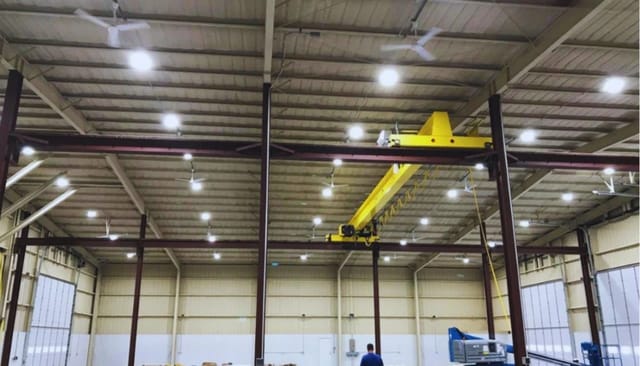
A 200W LED warehouse light can be a strong high-bay choice, but it is not automatically right for every warehouse. Use it when the fixture lumen output, distribution, mounting height, spacing, and controls meet the target light levels for the work being done. For rack aisles, loading zones, inspection areas, and forklift paths, ask for a photometric layout instead of buying by wattage alone.
How to Evaluate a 200W LED Warehouse Light Upgrade
Warehouse lighting upgrades fail when they start with wattage and stop there. A 200W LED fixture may replace an older HID high bay in many buildings, but the correct replacement depends on delivered lumens, beam distribution, ceiling height, rack layout, aisle width, reflectance, controls, and required light levels.
Start With the Work Area
Open storage, rack aisles, packing tables, shipping doors, forklift lanes, and inspection benches do not need the same distribution. UFO high bays may work well in open zones. Linear high bays may be better over aisles. Sensors may help in low-traffic areas, but they need commissioning so workers are not left in dark pockets.
What 200W Usually Means
Many 200W LED warehouse lights produce roughly 24,000 to 32,000 initial lumens. That is useful only if the optics place light where it is needed. Compare the IES file, not only the lumen line on the spec sheet.
Retrofit Checklist
- Measure mounting height, fixture spacing, aisle width, and rack height.
- Confirm target average and minimum footcandles for the task.
- Check voltage, mounting hardware, ambient temperature, emergency lighting, and controls.
- Model energy savings from actual watts, operating hours, and utility rate.
- Verify DLC/QPL and rebate rules before promising incentives.
LEDs often reduce energy and maintenance compared with HID, but savings vary by schedule, controls, labor cost, and the condition of the old system. A practical upgrade plan should show light levels, fixture count, controls behavior, and payback assumptions.
200W LED Warehouse Lights Need a Layout Check
A 200W LED high bay can be a strong warehouse upgrade, but wattage alone does not prove coverage. Check mounting height, fixture spacing, lumens, optics, aisle layout, glare, controls, voltage, and whether the new lights meet the target footcandles.
| Upgrade check | Why it matters |
|---|---|
| Mounting height | Controls spread, glare, and fixture count. |
| Controls | Occupancy sensors and daylight response can improve savings. |
| ROI | Include energy, labor, maintenance, and rebate assumptions. |
More Details to Consider
Upgrading to 200W LED Warehouse Lighting for Efficiency and
Performance
Warehouse managers today face numerous lighting challenges that hamper productivity and efficiency. Outdated high pressure sodium or metal halide fixtures cast uneven light that creates glare and shadows, reducing visibility across inventory areas and aisles. The high energy consumption also translates into utility costs that keep rising. Transitioning to 200W LED warehouse lighting presents an opportunity to address these pain points through enhanced illumination and significant energy savings. What are the Advantages of 200W LED Warehouse Lighting?
The most compelling benefit of 200W LED warehouse lights is dramatically improved energy efficiency. By producing over 20,000 lumens of bright white light while only drawing 200 watts of power, these LEDs minimize energy usage for the square footage illuminated. The latest 200W models offer over 150 lumens per watt, nearly double the efficiency of legacy HID fixtures. For context, upgrading a 100,000 square foot facility from 400W metal halide to 200W LEDs reduces power draw by around 60,000 watts. This translates into over $300,000 in electricity savings across a decade of operating 12 hours daily.
The energy efficiency of 200W LED warehouse lighting generates considerable cost savings that create a fast ROI. Electricity savings represent the main area, since running 200W LEDs 12 hours a day can save over $30,000 yearly for a 100,000 square foot building. Maintenance savings also add up over years of operation free from lamp and ballast replacements. And tax incentives, rebates, and lower insurance premiums thanks to safety certifications provide additional savings avenues. Investing in 200W LEDs today yields a typical payback period of less than two years.
What are the Technical Specifications of 200W LED Warehouse Lighting? With lumens defining the total light output across the visible color spectrum, 200W warehouse LEDs achieve over 20,000 lumens to ensure sufficient illumination. Top models even reach 24,000 or more lumens for extra brightness. This high lumen output combines with intelligent optical design for uniform light distribution without glare or hot spots throughout warehouse environments. Mounted at a typical height of 30-40 feet, each 200W LED fixture can effectively illuminate 3,500-4,000 square feet.
CRI indicates how accurately a light source renders colors compared to natural sunlight on a 0-100 scale. LED technology easily achieves CRI levels above 80 to provide the color representation and visual acuity essential in warehouse settings. Sorting inventory, spotting hazards, and reading labels all require high quality light for peak worker performance. A 200W LED specified at 83+ CRI generates vibrant, useful illumination to handle these visual tasks appropriately. How 200W LED Warehouse Lighting Can Improve Visibility and Safety.
The combination of higher lumen output, high CRI color quality, and reduced glare adds up to a giant leap forward in visibility compared to existing warehouse lighting. Workers can more clearly identify inventory items, spot potential hazards on floors or shelves, read labels on storage racks, and navigate aisles without any obstructed sight lines. 200W LEDs minimize shadows to reveal obstacles, debris, and spills that pose slip or trip risks. This enhanced illumination directly strengthens workplace safety through improved environmental visibility. Inadequate lighting frequently causes warehouse accidents and injuries while hindering productivity.
Transitioning to LED systems compliant with DLC Premium qualifications ensures alignment with recommended standards for safety, sustainability and performance. 200W LED fixtures minimize veiling reflections, stroboscopic effects, and flicker that contribute to visual fatigue and headaches over extended shifts. Well-lit environments keep staff alert and focused, leading to fewer accidents that endanger health or product inventory. What are the Main Benefits of 200W LED Warehouse Lighting? Simply put, the sharply higher light quality encourages workers to perform better across all metrics. Inventory picking rates accelerate as staff can spot items faster on well-lit shelves.
Order accuracy improves when labels and SKUs appear crisp and clear. Forklift operators navigate with confidence, enhancing efficiency. And increased visibility onto high racking reduces damage claims. Each 1% gain in productivity metrics like these directly boosts the bottom line. Advanced 200W LED warehouse fixtures provide customized lighting scenarios to match specialized zones or evolving needs. Integrated sensor controls enable dimming and automatic shut off in low traffic areas. Tunable color models with adjustable CCTs create cooler light for inspection zones or warmer ambiance where forklifts charge.
Group control systems can alter settings for entire banks of fixtures based on schedules or activity. These programmable lighting schemes optimize illumination where and when it matters most. Integration with Smart Building Systems. Network-connected 200W LEDs serve as intelligent nodes to transmit data and alerts to IoT platforms and building management systems. Embedded sensors can monitor occupancy, energy use, temperatures and more while sophisticated analytics track lighting health. The vital statistics amassed on environmental conditions and assets inform predictive maintenance while increasing sustainability.
And upgraded LED infrastructure lays the technology framework for warehouses of the future powered by IoT innovation.
Frequently Asked Questions
- Is a 200W LED warehouse light enough?
- A 200W LED warehouse light can be enough for many high-bay areas, but the right answer depends on mounting height, aisle layout, fixture distribution, target footcandles, rack height, reflectance, and the IES file. Do not size a warehouse by watts alone.
- How many lumens should a 200W LED warehouse light produce?
- Many 200W LED warehouse lights produce roughly 24,000 to 32,000 initial lumens, but delivered light on the floor depends on optics and spacing. Compare IES photometric data, not only catalog lumens.
- Can 200W LED fixtures replace 400W metal halide warehouse lights?
- Often, yes, but verify the replacement with a layout. Metal halide output depreciates over time, while LED fixtures use directional optics, so the equivalent wattage depends on maintained light levels and fixture placement.
- What should warehouse managers check before upgrading?
- Check ceiling height, fixture spacing, aisle widths, task areas, emergency lighting, controls, ambient temperature, sensor placement, voltage, mounting hardware, and whether a photometric plan is needed.

Ready to Upgrade Your LED Lighting?
Our lighting specialists can help compare options, confirm light levels, and quote the right products for your project.
Call 800-674-9420 or email [email protected]
Monday-Friday, 8am-5pm PST

About the Author
Dara Greaney is founder and CEO of LED Light Expert with deep expertise in commercial LED lighting, retrofits, and photometric planning.
Editing by David Peguero

Trusted by Thousands
Our customers love us — and we love them back.


-
 Free Shipping
On orders over $49.00
-
 Free Extended Warranty
Up to 7 Years Free Warranty On LED Lights
-
100% Satisfaction Guarantee
