Pole Mount Lighting – What is Slip Fit Versus Direct Arm Vs. Yoke
With outdoor lighting, figuring out where and how to mount the light can be a challenge. Pole mount lights come with different mount types that suit different needs and preferences. In this guide we explain what pole mounting of lights is and compare the three most common pole mounted lights options: slip fit, direct arm, and yoke.
What is a Pole Mounting of Lights?
Pole mounting of lights is the process of installing lighting fixtures on poles of various heights, shapes, and materials.
Light Pole mounting is required for parking lots and street lights to provide bright and adequate illumination. Pole mounting can also be used for other purposes, such as security, landscaping, or decoration.
Poles are usually made of aluminum, steel, or fiberglass, but concrete and wood poles can also be used in some situations. Poles can be either square or round in shape. Poles are also known as light poles or lamp posts, as they are commonly used to mount lighting fixtures.
Pole mounting of lights should be done properly and safely, following the relevant codes and standards. It is advisable to seek professional help for pole installation, as it involves electrical wiring, grounding, and structural stability.
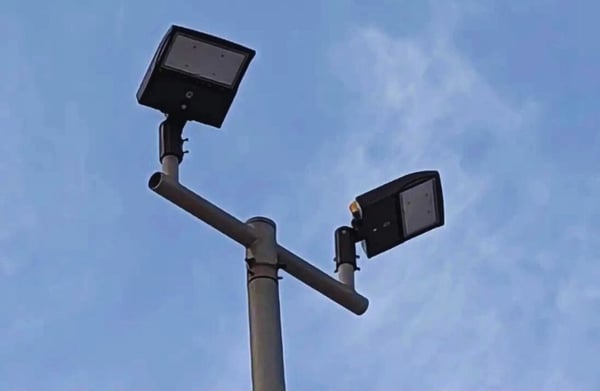
When it comes to purchasing a
light pole, there are two main options to choose from. These are:
• Tenon Mount at Top: You can opt to have the mount at the top of the pole, such as drilled holes and slip fit. Several other light pole options in the market allow users to mount at the top of the pole.
• Direct Arm Mount: This involves two bolt holes drilled on the side of the pole and the light fixture mounting to that.
You may also need to add top caps, such as rain caps or tenons, to protect the wiring and prevent water from entering the pole. Top caps are only necessary when the lights are on the side of the pole. These replaceable components of light poles are unnecessary when tenons or bullhorn brackets are mounted on top of the pole.
There are two different kinds of light poles: direct burial and anchor-based. Direct burial or embedded poles are installed by driving the shaft into the earth without a concrete base or anchor bolts. Anchor-based poles are fastened to a concrete foundation with anchor bolts, washers, and nuts. Either pole type can handle either mount type. It does not matter.
Common Types of Pole Mounting Options on Fixtures
The following are some of the most common types of mounting options on fixtures:
• Slip Fit:
Slip fit mount is the most commonly used mount option. On one end of the slip fitter, the
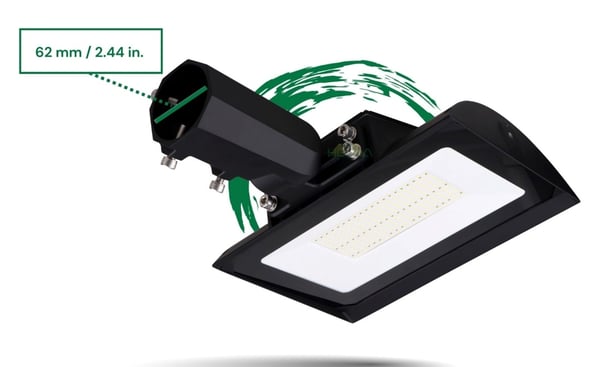
LED light fixture is attached and the hollow end slips over a round pole, or an arm extending from a pole. The slip fitter is then secured onto the round pole with screws. It is mainly for a round light pole tenon mounting bracket for one lighting fixture. However, combining slip fitter brackets with wall brackets makes side mounting on a square pole possible. Additionally, it is essential to note that more lighting fixtures can be added with the addition of a bullhorn bracket. These brackets are typically 2-3/8 inch in diameter in hole size.
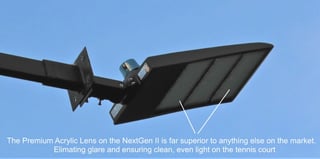
Slip fit mount is highly adjustable, has a more utilitarian appearance, and is most commonly used for sidewalk, street, and parking lot lighting.
Note in this picture that the size is 2.44 inches instead of 2.38 (2 3/8 inch) that allows some space for the mount to fit inside.
• Direct Arm: Direct arm mount is another name for horizontal straight arm mount. This mounting type is typically used on the sides of round or square poles. Direct arm is highly preferred for its more finished look. What makes the direct arm less attractive to some people is the fact that it is less adjustable. It can be used for
LED parking lot lights, street lights, wall packs, or canopy lights.
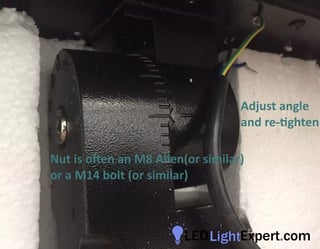
• Yoke: Yoke mount is also called trunnion mount or U bracket. It consists of a U-shaped bracket that attaches to the back of the light fixture and a stem that attaches to the pole or wall. The yoke mount allows the light fixture to be tilted up or down to adjust the beam angle. Yoke mount is typical when installing floodlights directly on junction boxes. Due to the ability of the bracket to adjust the floodlight angle, the light can shine upwards or downwards. This is useful for sign or accent lighting.
A common question that we receive is regarding the differences between yoke mounts and trunnion mounts. Yoke mounts consist of a U-shaped bracket that is typically used on flat surfaces such as walls or ceilings. They are easy to adjust after installation, if needed. On the other hand, trunnion mounts have a side bracket that allows for more creative mounting options, such as on a pole, arm, or wall. Nevertheless, it's important to mention that clients frequently utilize both types of mounts in comparable ways, based on their individual requirements.
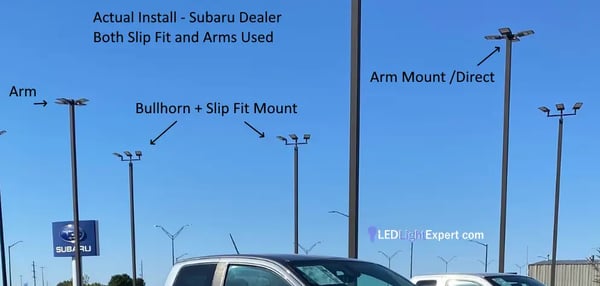
LED Parking lot mounts Explained - Slip Fit Mount or Arm Mount or Yoke - Light Pole Mounts
LED Parking lot mounts Explained - Slip Fit Mount or Arm Mount or Yoke. Which style pole mount do you have?
Usage of Tenons and Bullhorns to Mount
What are Tenon Adapters?
Tenon adapters are light fixtures that transform a light pole or wall into a slip-fit fixture 2.38 inches (2 and 3/8 inches equals 2.38 inches). They are used when changing small-diameter light poles to larger-diameter ones. Most light poles used for fixture conversion have 3-, 4-, and 5-inch diameters. Tenon adapters help to ensure that different lighting fixtures fit perfectly onto the pole for maximum illumination. They come in various shapes, which offer versatile mounting options. Various materials are used to manufacture these adapters, with steel fixtures as the most common ones. The popularity of steel fixtures is attributed to the fact that they can be primed, painted, or galvanized. They can also be used on square and round poles at any given height above the ground.
They are also built with at least four nut holes to provide a tight fit onto the poles. These nut holes, located on the tenon's wider side, fit perfectly over the holes in the poles. There are several types of tenon adapters, including the 4- and 7-inch 900 wall mount tenon plate, the flat slip mount with round and flat surfaces, and the round tenon reducer. Square tenons with and without a flange are one of the other varieties offered.
What are Bullhorns?
Pole light bullhorns, also known as light fixture bullhorns (but with the top-down instead of bottom-up), are mounting brackets that multiply one light into many, enhancing the amount of illumination in a space. They enable the installation of several lights, and one pole can hold up to four light fixtures. One distinct characteristic of bullhorn brackets is that they are typically curved at a junction, which provides space for fixing other lights. Bullhorn brackets operate as light fixture extenders and are optimized to light up different areas like driveways, streets, parking lots, highways, and pathways. They also have a hollow structure that facilitates the passage of electric wires that supply the lighting fixtures above. Their diameters vary to ensure a precise fit on the light pole. Most bullhorns are fastened to matching tenons that are then affixed to the light pole.
Common Bullhorns
Identifying the best bullhorn for your light pole can be daunting and challenging, considering the availability of a wide range of options in the market. Having an expert to help you determine the most appropriate brackets for your space is highly recommended. However, there are several aspects that, when you consider, can help you make the most informed decision. The primary considerations are what you are mounting to and the
number of lights you need.
The following are a few examples of the most common pole light bullhorns you can choose from:
1 Head Vs. 2 Head Vs. 3 Head Vs. 4 Head
Bullhorns are broadly categorized according to the number of arms (which translates to the number of lighting fixtures they can hold). A bullhorn bracket is considered to be either a 1 or 2 head considering the number of lights it allows to be installed per pole.
• 1 Head: Bullhorn adapters allow users to put only one slip fit mount light on a pole. This is just a tenon, not a bullhorn.
• 2 Head: These have two arms that facilitate the installation of two lighting fixtures on a pole.
• 3 Head: They have three arms, permitting three lighting fixtures to be placed on a single pole.
• 4 Head: These adapters have four arms for four lighting fixtures at 90 or 180 degrees.
Vertical Spoke
These are bullhorn brackets with a vertical tenon. In other words, the light fixture opening end of the Arm faces upward, usually at 90 degrees. Vertical spoke bullhorn brackets are designed to mount atop steel, concrete, and wood poles, and they are great for flood light, parking lot light, and other outdoor lighting fixtures.
Horizontal Spoke
As the name suggests, these are bullhorn brackets with horizontal tenons. The mounting arms are flat, ideal for parking lot, flood, or shoebox light fixtures.
Pole Mounts Must Match the Pole, Fixture and Site
Pole mount lighting is not just a bracket choice. The pole height, tenon size, arm style, bolt pattern, fixture weight, EPA wind load, wiring path, voltage, aiming, optics, controls, and service access all matter. For parking lots and sports areas, use a photometric plan before buying fixtures.
| Mount type | Use case |
|---|
| Slip fitter | Adjustable aiming on a tenon or round pole adapter. |
| Arm mount | Area lights where fixed position and clean appearance matter. |
| Yoke or trunnion | Flood lights that need precise aiming. |
Frequently Asked Questions
- What is pole mount lighting?
- Pole mount lighting uses brackets, tenons, bullhorns, arms, or slip-fit mounts to place outdoor fixtures on poles at the correct height and aiming angle.
- How do I choose a pole mount?
- Match the mount to the pole shape, tenon size, fixture weight, wind exposure, aiming needs, and number of fixtures.
- Can one pole hold more than one light?
- Yes, but the pole, bullhorn, EPA rating, fixture weight, and wind rating must support the full assembly.
Related Articles
Ready to Upgrade Your Lighting?
Our LED lighting experts can help you find the right fixtures for your project.
Call 800-674-9420 or email [email protected]
Monday–Friday, 8am–5pm PST





 Free Shipping
 Free Extended Warranty