

Quick Answer
For light poles, think in layers: grounding and bonding for the pole, proper surge protective devices for the circuit, and fixture-level protection for the driver. NFPA 780 covers lightning protection systems; local electrical code, site exposure, pole height, and utility service conditions decide the final design.
Surge Protection in Light Pole Setups and the NFPA 780 Standard
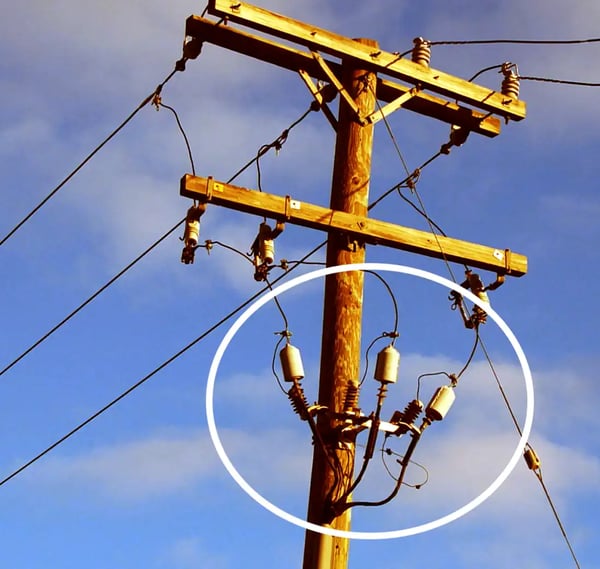
Quick author's note: there are many types of lightning surge arrestors, large and small. There are the big metal cylinders used on power and telephone poles, and there are the types used on light poles to protect the fixture. All do the same thing, with different pros, cons, and purposes. Much of this applies to both, but be aware there are some differences and we jump around.
Here are some utility-pole lightning surge arrestors:
What Is NFPA?
The National Fire Protection Association, shortened as NFPA, is an international non-profit established in 1896 to promote safety standards, advocacy, and training on electrical and fire-related hazards. The organization strives to eliminate injury, death, property damage, and other fire-related issues. NFPA expects individuals and organizations to adhere to its published codes and standards. NFPA is best known for those codes and standards, which usually start with "NFPA" followed by a number or a number-letter combination, all for the purpose of enhancing safety. As of recent figures, the organization has around 50,000 members and 9,000 volunteers across roughly 250 technical committees.
Many safety organizations focus almost exclusively on workplace safety. NFPA is different because it focuses on everyone's safety, and its codes are commonly used in residential situations today. Many people now prefer installing NFPA-approved devices in their homes, and to promote fire safety among children the organization created its mascot, "Sparky the Fire Dog." One major challenge is keeping up with fast-advancing electrical systems, because safety requirements are unique to each system and change as new technology enters.
What Is NFPA 780?
To understand NFPA 780, it helps to first know what a lightning protection system is. A lightning protection system is designed to lessen or prevent damage from a lightning strike. It also protects the internal electrical components of a structure, such as LED drivers, helping avoid electrocutions and fires. Electrical-system risks from lightning are well known.
The likelihood of being struck is higher for taller structures. Water tanks, railings, towers, antennas, chimneys, and other metal structures are examples of vulnerable constructions. Lightning is brief yet frequent, and it looks for low-impedance routes to earth. High-impedance routes frequently cause mechanical damage and heat. Some requirements are straightforward, like bonding conductive objects that might be electrified by lightning.
NFPA 780 is the Standard for the Installation of Lightning Protection Systems. It covers lightning protection techniques and hazards, and its guidance has stood the test of time. Recent editions of NFPA 780 provide conventional lightning protection methods for a range of structures, including ordinary buildings, watercraft, wind-turbine structures, and constructions made of combustible or explosive materials. The standard's goal is to protect people and property from the risks of lightning strikes.
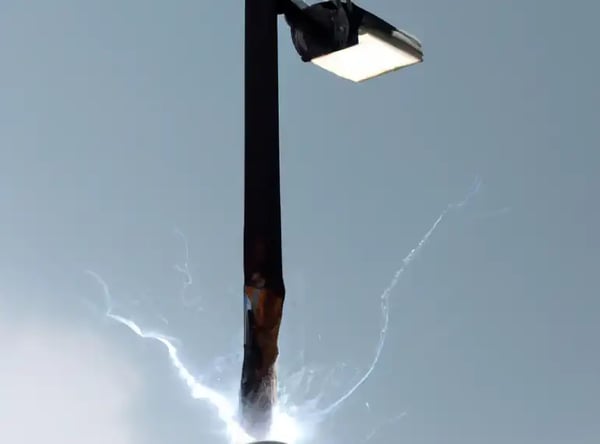
Lightning is not messing around - a strike to a pole can melt the pole:
Why Is Lightning Protection Necessary?
Lightning discharges have been estimated to produce between a few thousand amps and over 200,000 amps of electrical energy - enough to power 500,000 100-watt lamps. Despite a relatively brief lifespan, usually around 200 microseconds, a lightning discharge can cause significant harm, especially to LED lights.
An exterior lightning protection system aims to intercept, channel, and safely diffuse a lightning strike. Without one, a building's structure, its electronic components, and anyone in or near it are all at risk. If lightning cannot find a safe route to earth, it can significantly harm a structure and even injure or kill a person. In a strike, lightning uses every available conductor to find a route to ground - electrical wires, cable and phone lines, water pipes, computers, and even the building's structure - and can jump between structures through side flashes, igniting fires or explosions. Electronics and appliances risk breaking down if a building takes a strike.
In a private residence, the homeowner decides whether an LED surge protective device is needed based on the likelihood that lightning could destroy or damage the building. National rules do not mandate a lightning protection system in every home, but it is a legal requirement for certain building types.
What Is a Lightning Protection System on Outdoor Light Poles?
Outdoor lighting fixtures can be mounted on a building's exterior walls or in open spaces. Most of us are familiar with using light poles for outdoor lighting. These poles rise several feet high depending on the application, and their height places them at high risk of a lightning strike. Outdoor light poles therefore also need protection against direct strikes. Surge protection is critically important in LED lights, and fortunately there are lightning protection systems for these poles.
It is also possible to purchase an outdoor lighting system with pole protection included. In addition to the protection system, there are three other aspects to consider when buying a light pole: material, galvanization, and coating.
Guidelines for a Basic Lightning Protection System
A complete lightning protection system includes strike termination devices, surge protective devices, interconnecting conductors, bonding conductors, grounding electrodes, and other connectors. The key elements an optimal system should have, per the standard, are:
- Material used - Based on environmental and structural criteria, the material must be chosen from the Class I or Class II materials list in the standard.
- Strike termination devices - A conductive component, usually metal, capable of receiving the lightning strike and conducting it to ground.
- Zones of protection - Determined by the geometry of the building or structure. The angle method, rolling sphere method, and air terminal placements are used to determine a structure's protected zones.
- Conductors - The primary conductor should connect all strike termination elements and link to ground through two or more pathways from the strike termination device.
- Conductor connectors and fasteners - Connections should be bolted, exothermically welded, crimp type, or high compression, and must withstand a pull test of 890 N.
- Grounding electrodes - Connected to one down conductor. Soil type and corrosion determine the best ground-rod material; options include stainless steel, copper-clad steel, and solid copper.
- Common bonding of the grounded system - All grounded metallic conductors, including metallic piping that could become a lightning-current path, must connect to the system to create a single ground potential.
- Potential equalization - Joining all metal conducting components brings their potential levels to parity. Three stages are used: ground level, roof level, and intermediate level.
- Structural metallic systems - If the structure's metallic framework provides a continuous current path per the standard, it can serve as the primary conductor.
- Surge protection - Type I and II surge protection equipment, surge arresters, and surge protectors inside the structure. Surge protective devices (SPDs) must be fitted at the load side of any device connected to an incoming or branch circuit line.
What Are the Lightning Protection Requirements?
Lightning protection is not always a blanket legal obligation, and requirements vary by jurisdiction and building type. Where risk assessments apply, they should be performed on a regular schedule as required by local code. The practical takeaway: those who don't prepare will pay for it later.
Surge Protection Is a System, Not a Single Part
Light poles are exposed equipment: long conductors, outdoor service, storms, switching events, and metal structures all raise the risk. A surge protective device helps, but it works best with correct grounding, bonding, wire routing, fixture driver compatibility, weather protection, and a maintenance plan.
| Checkpoint | Why it matters |
|---|---|
| SPD location | Protection may be needed at the panel, pole base, fixture, or more than one point. |
| Voltage match | The SPD and fixture driver must match the actual service voltage and wiring method. |
| Grounding and bonding | A poor grounding path can leave surge energy with nowhere useful to go. |
| Serviceability | Choose replaceable or inspectable protection when poles are hard to access. |
Frequently Asked Questions
- What is NFPA 780?
- NFPA 780 is a standard for installing lightning protection systems. It is relevant when a site needs a complete lightning-protection design, but it does not replace local electrical code or project-specific engineering.
- Do light poles need surge protection?
- Outdoor light poles should be reviewed for surge exposure, grounding, bonding, voltage, fixture driver protection, and service access. The right protection may be at the panel, pole base, fixture, or more than one location.
- Is a surge protector the same as lightning protection?
- No. A surge protective device helps limit transient voltage. A lightning protection system is a larger design that may include strike termination, conductors, bonding, grounding, and surge protection.
- Who should design light-pole protection?
- Use a qualified electrician, engineer, or lightning-protection professional when code requirements, tall poles, exposed sites, or critical facilities are involved.

Ready to Upgrade Your LED Lighting?
Our lighting specialists can help compare options, confirm light levels, and quote the right products for your project.
Call 800-674-9420 or email [email protected]
Monday-Friday, 8am-5pm PST

About the Author
Dara Greaney is founder and CEO of LED Light Expert with deep expertise in commercial LED lighting, retrofits, and photometric planning.
Editing by David Peguero

Trusted by Thousands
Our customers love us — and we love them back.


-
 Free Shipping
On orders over $49.00
-
 Free Extended Warranty
Up to 7 Years Free Warranty On LED Lights
-
100% Satisfaction Guarantee
