


Quick Answer
When buying LED light bulbs, compare lumens first, then base type, voltage, color temperature, CRI, dimmer compatibility, enclosure rating, wet or damp rating, certifications, and warranty. Do not choose by wattage alone. A good LED bulb should fit the fixture, provide the right brightness and color, work with the controls already installed, and be rated for the environment where it will run.
7 Things to Consider When Buying LED Light Bulbs
LED light bulbs are now the default choice for many homes, offices, warehouses, garages, and commercial fixtures because they use less energy, start instantly, and are available in more shapes and color temperatures than older lamp types. The mistake is buying by wattage alone. With LEDs, wattage tells you energy use; lumens tell you brightness.
Use this checklist before buying so the bulb fits the fixture, produces the right light, works with your controls, and survives the environment.
1. Lumens and Brightness
Compare lumen output first. A traditional 60-watt incandescent bulb produced roughly 800 lumens, but an LED can produce similar brightness with far less wattage. For task lighting, high ceilings, garages, and outdoor fixtures, the right lumen target matters more than the old wattage label.
Size the target to the room, not the old bulb. A quick estimate is the floor area multiplied by the target light level in footcandles. A 100-square-foot living room at 10 to 20 footcandles needs roughly 1,000 to 2,000 lumens; a 250-square-foot dining room at a similar level lands near 5,000 lumens. Under-lit rooms cause eye strain and fatigue, while over-bright, glary light is just as uncomfortable. Browse the full LED light bulb range once you know the lumen target.
2. Base Type and Fixture Fit
Check the base before ordering: E26, E39, GU10, bi-pin, mogul, bayonet, and tube bases are not interchangeable. Our light bulb bases and types guide breaks down which base fits which socket. Also check the physical size. Some corn bulbs, filament bulbs, PAR lamps, and high-output replacements are too large for enclosed or shallow fixtures.
3. Voltage and Driver Compatibility
Household bulbs are often 120V, while commercial and industrial replacements may be 120-277V, 277V, or another range. Match the bulb to the fixture and circuit. For retrofit lamps, check whether the ballast must be bypassed or removed.
4. Color Temperature
Color temperature is measured in Kelvin. Use 2700K to 3000K for warm residential and hospitality spaces, 3500K to 4000K for neutral offices and general work areas, and 5000K where daylight-like task visibility is needed. Very cool light is not automatically better; it can feel harsh if the fixture has poor glare control. For the underlying theory, see our guide to LED color temperatures.
When one space serves several uses, tunable LED technology lets you adjust color temperature, and often wattage, on a single fixture in real time rather than committing to one Kelvin value.
5. CRI and Color Quality
Color Rendering Index, or CRI, estimates how naturally colors appear under a light source. 80+ CRI is a common baseline for general indoor use. Choose 90+ CRI for kitchens, retail, salons, studios, inspection work, art, and other color-sensitive spaces.
6. Dimming and Controls
Not every LED bulb is dimmable, and not every dimmable LED works with every dimmer. Check the bulb specification sheet and the dimmer compatibility list. Incompatibility can cause flicker, buzzing, limited dimming range, or lights that fail to turn off cleanly.
7. Location Rating, Certification, and Warranty
For bathrooms, patios, exterior fixtures, garages, and industrial spaces, check damp-location, wet-location, IP, and enclosed-fixture ratings. Look for appropriate safety and efficiency certifications for the application. DOE notes that quality LED products can last much longer than older lamp types, but lifetime depends on heat, driver quality, fixture ventilation, and duty cycle.
LED Wattage Equivalents at a Glance
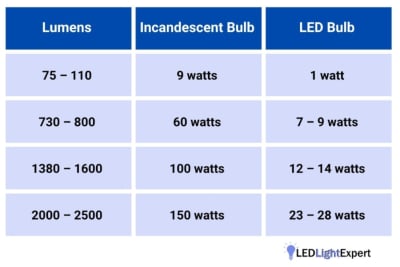
Because LED brightness is measured in lumens, not watts, the old wattage habit misleads. Use these approximate equivalents as a starting point, then confirm the lumen rating on the product spec sheet:
| Old incandescent | Approx. light output | Typical LED wattage |
|---|---|---|
| 40 W | ~450 lumens | 4-6 W |
| 60 W | ~800 lumens | 7-9 W |
| 75 W | ~1,100 lumens | 9-12 W |
| 100 W | ~1,600 lumens | 13-16 W |
| 150 W | ~2,600 lumens | 22-26 W |
Key Features to Compare
The Seven Checks Before You Buy
For LED light bulbs, do not shop by watts alone. Check lumens, color temperature, bulb shape, base type, fixture rating, dimmer compatibility, voltage, and beam angle. The right bulb should fit physically, produce the right light output, match the room color, and work with the controls already installed.
| Check | Why it matters |
|---|---|
| Lumens | Compares actual brightness instead of old incandescent wattage. |
| Color temperature | Warm, neutral, or cool appearance changes how the room feels. |
| Base and shape | Prevents buying a bulb that will not fit the socket or fixture. |
| Dimming | Dimmable bulbs still need a compatible LED-rated dimmer. |
More Details to Consider
LED bulbs should be chosen by lumens, base type, shape, voltage, beam angle, CCT, CRI, dimming compatibility, fixture rating, and location rating. Wattage only tells you energy use.
A bulb that is too large, not rated for an enclosed fixture, or incompatible with a dimmer can flicker, overheat, or fail early. Always check the spec sheet before using specialty replacements.
For comfort, match brightness and color temperature to the room and task. Very bright or very cool light can feel harsh if the fixture has poor diffusion or glare control.
Frequently Asked Questions
- What should I look for when buying LED light bulbs?
- Start with lumens, base type, voltage, color temperature, CRI, dimmer compatibility, fixture rating, wet or damp rating, certifications, and warranty. Wattage tells you energy use, not brightness.
- How much do LED lights cost?
- LED light prices vary by bulb type, output, controls, rating, and brand. A basic household bulb costs much less than a high-output corn bulb, filament bulb, dimmable specialty lamp, or wet-location commercial replacement. Compare total cost by energy use, lifespan rating, and replacement labor, not just shelf price.
- Which LED color temperature should I choose?
- Use 2700K to 3000K for warm residential and hospitality spaces, 3500K to 4000K for neutral offices and general work areas, and 5000K where daylight-like task visibility is needed. The best color temperature depends on the room and the task.
- Do LED bulbs work with all dimmers?
- No. Dimmable LED bulbs need compatible LED-rated dimmers, and not every dimmable bulb works well with every control. Check the bulb specification sheet, dimmer compatibility list, minimum load, and whether the fixture uses forward-phase or reverse-phase dimming.

Ready to Upgrade Your LED Lighting?
Our lighting specialists can help compare options, confirm light levels, and quote the right products for your project.
Call 800-674-9420 or email [email protected]
Monday-Friday, 8am-5pm PST

About the Author
Dara Greaney is founder and CEO of LED Light Expert with deep expertise in commercial LED lighting, retrofits, and photometric planning.
Editing by David Peguero

Trusted by Thousands
Our customers love us — and we love them back.


-
 Free Shipping
On orders over $49.00
-
 Free Extended Warranty
Up to 7 Years Free Warranty On LED Lights
-
100% Satisfaction Guarantee
