


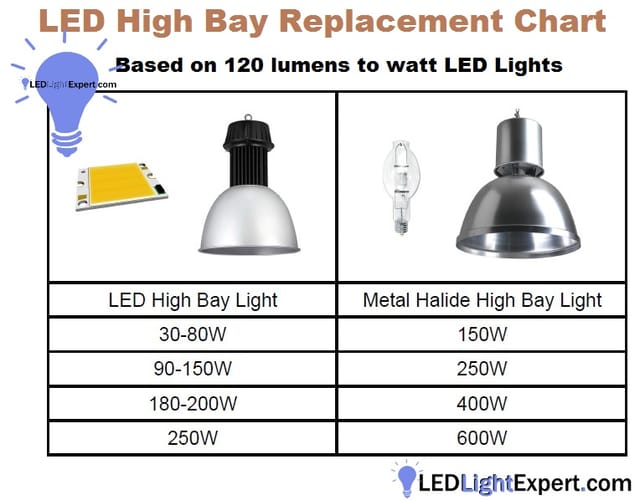
Lumens measure light output brightness.
General guidelines: 400-800 lumens for table lamps, 1,500-3,000 for room lighting, and 10,000-50,000+ for commercial and outdoor. To replace old bulbs: a 60W incandescent equals about 800 lumens, 100W equals 1,600 lumens in LED equivalent.
How many lumens do I need from my LED Light? How Bright?
What is a lumen?
A lumen is a unit of measurement that indicates how much visible light is emitted by a source. The more lumens, the brighter the light. For example, a standard 100-watt incandescent light bulb produces about 1600 lumens of light.
Lumens are different from watts, which measure the amount of electricity used by a light source. With new and more energy-efficient LED technology, we can no longer rely on watts to indicate how bright a light bulb is. Instead, we have to look at lumens to compare the brightness of different types of lights.
How many lumens do I need?
The brightness of LED lights depends on how many lumens they produce. Lumens are a measure of the total amount of visible light from a source. The more lumens, the brighter the light. However, the number of lumens you need from your LED light also depends on other factors, such as the size and shape of the area you want to illuminate, the height and angle of the light fixture, the color and temperature of the light, and the purpose and mood of the lighting.
To help you decide how many lumens you need from your LED light, you can use some general guidelines based on different types of lighting applications. For example:
- For high bay LED lighting, such as in warehouses or factories, you may need about 1,000 lumens per square meter for bright lighting, or about 500 lumens per square meter for adequate lighting. This means that if you have a 20 by 20 meter area, you may need about 400,000 lumens for bright lighting, or about 200,000 lumens for adequate lighting. You can achieve this by using multiple LED high bay lights with different wattages and beam angles, depending on the height and layout of your ceiling.
- For LED parking lot lighting, such as in commercial or residential areas, you may need about 100 to 200 lumens per square meter for bright and safe lighting, or about 50 to 100 lumens per square meter for adequate and economical lighting. This means that if you have a 10 by 10 meter parking lot, you may need about 10,000 to 20,000 lumens for bright lighting, or about 5,000 to 10,000 lumens for adequate lighting. You can achieve this by using one or two LED parking lot lights with different wattages and beam angles, depending on the height and location of your pole.
These are just some examples of how to estimate how many lumens you need from your LED light.
Lumens vs Footcandles and Lux
Footcandles or lux, which is just the metric version, tells us how much light gets to a given square meter. If you are installing LED high bay lights up at 30 feet, but even if they are 26,000 lumens, very little of that light may hit the floor or ‘working area’. Lux or footcandles tells us how much light lands at that specific spot on the ground.
Think of it in much simpler terms. If you are doing those warehouse high bay linear lights, what counts is how many of those lumens actually make it to the floor. That way there is an even, bright light across the warehouse floor.
The way to get there is to look at lumens, factor in light angle and number of fixtures and get to the footcandles. That requires a computer model.
Basic vs Computer Lighting Design
Lighting is a fascinating and complex science that involves the study of photometrics, which are the measurements of light and its effects. Photometric data can be stored in computer files called IES files, which stand for Illuminating Engineering Society. These files can be used to simulate and design lighting systems for various applications and environments.
- Basic Light Design: Basic lighting design is a simple and intuitive method that relies on common sense and experience. It does not require any sophisticated tools or calculations, but rather some basic knowledge of lighting principles and techniques. There are so many variables in lighting that you have to decide what your goals are ahead of time. Determine what your options are with installation of the fixtures themselves. Can you change poles? Can you run dimming wire? Can you change a small section at first to see if you like it? Doing a little planning on the front end will help you achieve great lighting results.
- Computer Light Design: Computer lighting design uses software to model light levels, fixture placement, beam angles, and surface reflectance. For small projects, a full design may not be cost effective. For larger buildings or projects with multiple stakeholders, a photometric study can confirm the right amount of light, fixture count, and brightness before purchase.
Use lumens as the starting point, then confirm the fixture layout, beam angle, mounting height, and target light level before choosing the final product.
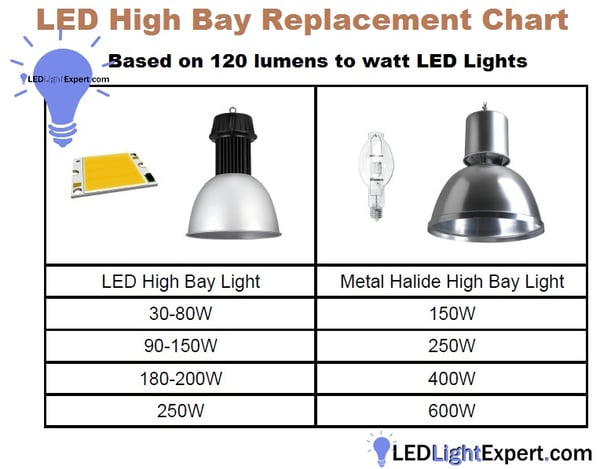
*2017 numbers shown in chart. Call or message for current numbers.
Frequently Asked Questions
- How many lumens do I need?
- It depends on the application. The U.S. Department of Energy notes that residential rooms typically need 400-800 lumens for accent lighting and 1,500-3,000 for general illumination. Offices target 300-500 lux (30-50 footcandles). Warehouses and industrial spaces need 10,000-50,000+ lumens per fixture depending on mounting height and spacing. Always factor in ceiling height, surface reflectance, and beam angle.
- How bright is 1600 lumens?
- 1,600 lumens equals a traditional 100-watt incandescent bulb — bright enough to light a standard bedroom or small living room from a single ceiling fixture. In LED, you reach 1,600 lumens from roughly 15-20 watts, which is why comparing lumens matters more than comparing watts.
- How bright is 10,000 lumens?
- 10,000 lumens is commercial-grade output, comparable to a 100-watt metal halide. It can light a 100-square-meter area at roughly 100 lux — suitable for a workshop, retail space, or small warehouse bay mounted at 12-15 feet.
- How bright is 180 lumens?
- 180 lumens is about equal to a 25-watt incandescent bulb. Enough for a small accent light, a pathway solar fixture, or under-cabinet task lighting. Not sufficient for general room lighting, but useful for targeted or decorative applications.
- Is 1600 lumens bright?
- Yes. 1,600 lumens matches a 100-watt incandescent, which was the standard bright household bulb. For a single fixture in a 150-200 square foot room, 1,600 lumens provides comfortable general lighting. Larger spaces or commercial use will need multiple fixtures or higher-output LEDs.
- How bright is 20 lumens?
- 20 lumens is very dim — roughly equivalent to a single candle. Appropriate for night lights, indicator lights, or emergency exit markers. At 20 lumens you can navigate a room but cannot read or perform detailed tasks.
- How bright is 4,000 lumens?
- 4,000 lumens equals roughly a 200-watt incandescent or a 50-watt metal halide. It is a strong work light level — enough for a single-car garage, a large bathroom, or a 2x2 LED troffer in an office ceiling grid. Many portable LED work lights target this output.
- How bright is 20,000 lumens?
- 20,000 lumens is high-output commercial lighting territory — equivalent to a 250-watt metal halide or a mid-range LED high bay. Mounted at 20-25 feet, a single 20,000-lumen fixture can adequately light about 400 square feet of warehouse floor. Common in distribution centers, manufacturing lines, and large retail spaces.
Related Articles


Ready to Upgrade Your Lighting?
Our lighting specialists can help you find the perfect solution for your project.
Call 800-674-9420
or email [email protected]
Monday–Friday, 5am–6pm PT

Dara Greaney is founder and CEO of LED Light Expert with deep expertise in LED fixtures and light design.
Editing by David Peguero.
2 Comments
Glenn Humphrey
2 by 4 led drop i n 4 lights for 10 foot hanging ceiling how watts per square foot i
Joanne Haas
Do u install parking garage lighting? I live in a condo with a 5 story garage currently undergoing renovations. We would like to replace current lighting with LED lighting.i am looking for companies that would guide us as to fixtures we would need and do installation too. If u do not do it can u recommend someone? Thank you.


