

Quick Answer
Yes in some fixtures, but base, voltage, ballast bypass, size, heat, enclosed rating, and distribution must be checked.
LED Corn Light Bulbs as Metal Halide Replacements
LED corn bulbs can replace some metal halide lamps, but the retrofit has to be planned. Base type, fixture size, heat, ballast removal or bypass, voltage, orientation, enclosed-fixture rating, and safety listing all matter.
What to Check First
- Confirm the old lamp wattage, base, fixture dimensions, voltage, and whether the fixture is open or enclosed.
- Follow the product instructions for ballast bypass, direct-wire installation, or compatible operation.
- Check horizontal or vertical operation, surge exposure, heat, and fixture condition before reuse.
Application Decision Table
| Use Case | Practical Guidance |
|---|---|
| Shoebox or area fixture | Confirm the corn bulb fits, controls heat, and distributes light where the old reflector aimed it. |
| Wall pack or barn light | Check enclosed rating, base orientation, lens clearance, and gasket condition. |
| High bay retrofit | Compare corn bulbs with full fixture replacement when reflectors, optics, or access are poor. |
Common Mistakes to Avoid
- Leaving an old ballast in place when the new lamp requires bypass wiring.
- Assuming the same wattage replacement is the correct LED output.
- Using a corn bulb in an enclosed fixture without checking the product rating.
Retrofit Fit Checklist
A corn bulb replacement should be selected from the existing fixture outward. Confirm the old lamp wattage, base type, socket condition, fixture dimensions, voltage, ballast status, and whether the housing is enclosed. Then compare delivered lumens and distribution. A corn bulb may produce enough light on paper but still perform poorly if the fixture traps heat, blocks the LED panels, aims light into the reflector incorrectly, or leaves the driver in a high-temperature pocket.
| Retrofit question | Why it matters |
|---|---|
| Ballast or bypass? | Many LED corn bulbs require direct wire after the old HID ballast is removed or bypassed. |
| Base and orientation? | E26, E39, vertical, and horizontal installations can change fit, heat, and beam distribution. |
| Enough room for cooling? | LED retrofit lamps need airflow and clearance so the driver and heat sink stay within rating. |
| New fixture instead? | When optics, heat, or fixture condition are poor, a complete LED fixture can be the better long-term answer. |
Use corn bulbs when the housing is still sound, the socket is compatible, the light pattern fits the job, and the installation can be wired safely. Use a new fixture when the old reflector, lens, ballast compartment, or mounting condition is part of the problem.
Why They Are Called Corn Bulbs
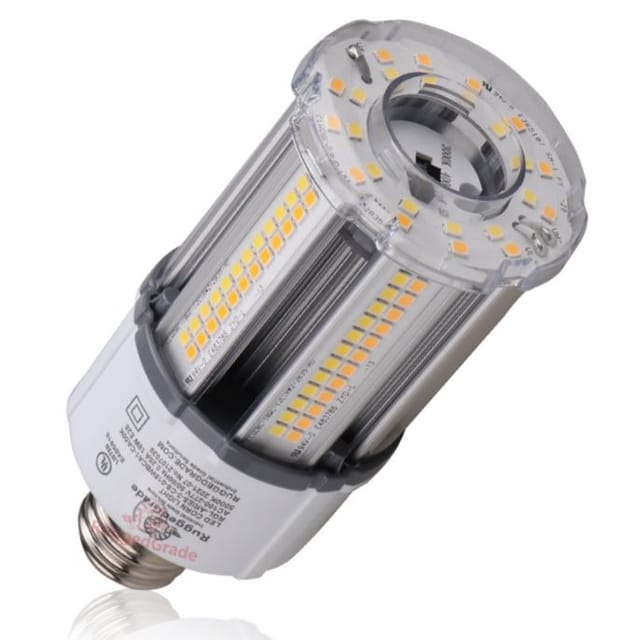
LED corn bulbs get the name from the rows of LED chips around the lamp body, which look like kernels on a corn cob. That layout can send light in many directions inside a legacy fixture, making it useful for some post-top, wall pack, barn light, shoebox, and high-bay retrofits. The same shape can also create problems if the fixture blocks the LED panels, traps heat, or was designed around an HID arc tube in a reflector. Fit and heat matter as much as raw lumens.
Ballast Bypass and Replacement Starting Points
Many metal halide replacements require the old ballast to be removed or bypassed so the LED lamp is wired directly to line voltage. The work is straightforward for a qualified electrician, but it is still electrical work: power must be shut off, voltage confirmed, the ballast disconnected, and the socket wired exactly as the lamp instructions require. Leaving the wrong ballast in place can cause flicker, failure, or an unsafe installation.
| Old HID lamp | Common LED starting range | What to confirm |
|---|---|---|
| 1000W metal halide | Roughly 300W LED, depending on fixture and target light level | Mounting height, distribution, heat, voltage, and whether a full fixture is better. |
| 400W metal halide | Often 120W-150W LED, sometimes more or less by application | Mean lumens, reflector losses, pole or ceiling spacing, and glare. |
| 250W metal halide | Often around 80W LED as a starting point | Fixture size, socket orientation, and enclosed rating. |
| 150W metal halide | Often around 54W LED as a starting point | Task level, base type, voltage, and whether the lamp has enough cooling space. |
Corn bulbs can be a lower-cost retrofit when the existing fixture is still sound. They also bring instant-on operation and lower maintenance compared with many HID lamps. When optics, weather seals, lenses, sockets, or housings are tired, a complete LED fixture is usually the cleaner long-term fix.
More Details to Consider
LED Corn Light Bulbs - The Metal Halide LED Replacements! Are you still buying metal halide bulbs for your lighting needs? If so, you might be wasting a lot of money and time on bulbs, ballasts, and energy bills. Not to mention the hassle of climbing up a ladder or renting a scissor lift to change them. Now is the time to go LED and it has never been easier with LED Corn Bulbs. LED corn bulbs are named after their resemblance to corn on the cob.
They have rows of LED chips that emit light in all directions, creating a bright and uniform illumination. They are designed to replace metal halide bulbs in existing fixtures by simply screwing them into the socket. However, you may have to bypass or remove the ballast first, which will save you more money in the long run. LED retrofits have existed for years and they are still a great product for many uses.
But LED corn bulbs have some advantages over them, such as: • Higher lumen output: We have E39 LED bulbs in lumen outputs from 4,000 all the way up to 40,000, which can replace 1000 watt metal halide bulbs. • Easier installation: You don't need to modify the fixture or use any adapters. Just screw in the bulb and you are done. • Lower cost: LED corn bulbs are more affordable than LED retrofits, especially for high wattage applications.
Here are some of the benefits of using LED corn bulbs instead of metal halide bulbs: Energy Savings: LED bulbs can be 30-60% more efficient than metal halide bulbs. Metal halide bulbs typically get about 75 lumens per watt, while our LED light bulbs get 115 lumens per watt. Some of the old metal halide bulbs were as low as 40 lumens per watt, so the savings could be even bigger. Low Maintenance: With rated lives of 50,000 hours and up - decades at typical run times - you don't have to worry about changing bulbs frequently.
That long service life keeps maintenance costs way down. You also don't have to deal with ballasts that can fail or cause flickering. Low Heat: LED corn bulbs are significantly cooler than metal halide bulbs, improving safety and reducing fire risk. They also keep your building cooler and reduce your air conditioning bill. Instant On: Unlike metal halide bulbs that take several minutes to reach full brightness, LED bulbs turn on instantly.
This means you can see what you are doing right away and avoid wasting energy on warm-up time. On most fixtures, bypassing the ballast is easy. You just need to disconnect the wires from the ballast and connect them directly to the socket. The ballast can still be there, just not wired in. This way, you avoid any compatibility issues or power losses from the ballast. How Many Watts of LED to Replace Metal Halide?
Here is a general guide on how many watts of LED light you need to replace metal halide:
- 1000 watts of metal halide needs 300 watts of LED.
- 400 watts of metal halide needs 120-150 watts of LED.
- 320 watts of metal halide needs 100-120 watts of LED.
- 250 watts of metal halide needs 80 watts of LED.
- 150 watts of metal halide needs 54 watts of LED.
- 100 watts of metal halide needs 36 watts of LED.
Of course, this may vary depending on your specific application and lighting requirements. You should always check the lumen output and beam angle of the LED bulb before buying it. If you are ready to make the switch to LED corn light bulbs, we have a wide selection of products for you to choose from.
Frequently Asked Questions
- Can LED corn bulbs replace metal halide lamps?
- Yes in some fixtures, but base, voltage, ballast bypass, size, heat, enclosed rating, and distribution must be checked.
- Do LED corn bulbs need the ballast removed?
- Many corn bulbs require ballast bypass or direct-wire installation. Always follow the product instructions.
- What wattage LED replaces metal halide?
- Use delivered lumens and application needs, not wattage alone, to compare replacements.
- Are corn bulbs better than full fixture replacement?
- Sometimes. Full fixture replacement may be better when optics, heat, wiring, or fixture condition are poor.

Ready to Upgrade Your LED Lighting?
Our lighting specialists can help compare options, confirm light levels, and quote products that fit the site.
Call 800-674-9420 or email [email protected]
Monday-Friday, 8am-5pm PST

About the Author
Dara Greaney is founder and CEO of LED Light Expert with deep expertise in commercial LED lighting, retrofits, and photometric planning.
Editing by David Peguero

Trusted by Thousands
Our customers love us — and we love them back.


-
 Free Shipping
On orders over $49.00
-
 Free Extended Warranty
Up to 7 Years Free Warranty On LED Lights
-
100% Satisfaction Guarantee
