

Quick Answer
Kelvin selectable bulbs let users choose light appearance, usually warm, neutral, or cool white, with a switch. They are useful when the final CCT preference is uncertain.
Kelvin Selectable Bulbs
Kelvin selectable bulbs solve a real problem: many users do not know whether warm, neutral, or cool white will look best until the lights are installed. Selectable CCT gives flexibility, but the final choice should still match the task, fixture, dimming, glare, and room finish.
What to Check First
- Mounting height, fixture location, voltage, controls, and service access.
- Target light level, uniformity, glare, spill light, and operating schedule.
- Safety listing, warranty, environmental rating, and current code or program requirements.
- Whether a photometric plan or sample installation is needed before ordering.
Practical Buying Advice
Do not buy by wattage, brightness claims, or product names alone. Compare the fixture data, application, layout, and maintenance plan. For uncertain projects, choose adjustable settings only when the final settings will be locked, labeled, and documented.
Decision Table
| Question | Why It Matters |
|---|---|
| What task is being lit? | The task decides output, optics, controls, and glare limits. |
| What can go wrong? | Heat, glare, poor aiming, wrong listing, or bad controls can erase the benefit. |
| How will it be maintained? | Access, documentation, and replacement parts affect lifetime value. |
When Kelvin Selectable Bulbs Are Useful
Kelvin selectable light bulbs are useful when the buyer is not sure whether the space should be warm, neutral, cool, or daylight-like. Instead of stocking several color temperatures, one adjustable CCT bulb can be set before installation or with a small switch on the lamp, depending on the product design.
| Setting | Appearance | Common fit |
|---|---|---|
| 2200K-2700K | Very warm to warm white. | Hospitality, relaxed residential spaces, and low-glare evening light. |
| 3000K-4000K | Warm-neutral to neutral white. | Garages, offices, kitchens, retail, and general work areas. |
| 5000K+ | Cool or daylight-like. | Warehouses, utility areas, task lighting, and security-focused spaces. |
What Is a Kelvin Selectable Light Bulb?
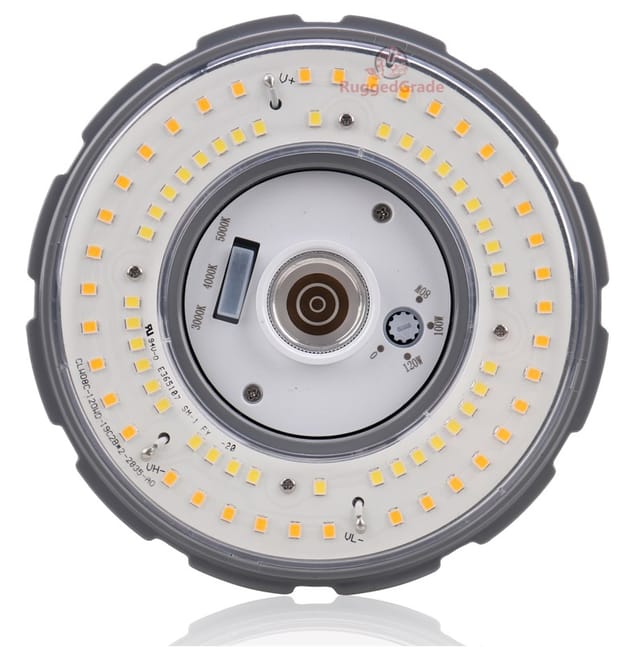
Kelvin selectable bulbs, also called tunable bulbs, let you choose the Kelvin (light color) right on the fixture. Typically a small slide switch moves you from 3000K warm to 4000K neutral to 5000K bright white, giving you real control over the mood of a space, or simply getting a room's lights to match. Kelvin selectable corn light bulbs are one of the more useful innovations in LED lighting: customers can customize color on site, which saves time and money through design and installation, and they suit retrofit projects because of that adaptability. They also carry a high CRI (color rendering index) so colors look accurate and vibrant, and a corn bulb typically lasts around 50,000 hours - an eco-friendly, low-maintenance choice.

What Are Corn Light Bulbs?
Corn light bulbs are LED bulbs with rows of LED chips arranged around a tube so they resemble corn on the cob - anywhere from about 80 to 108 diodes depending on style and size. They are built as energy-efficient replacements for HID and HPS lamps, packing a large LED array onto a metal body to deliver a lot of light while keeping a wide color spectrum. Most offer a 360-degree beam for full coverage around and above the fixture, and they install two ways: bypassing the old HID ballast to wire directly to 120 or 277V, or plug-and-play with a built-in driver. They come in two bases - E26 (the standard 120V base found in homes) and E39 (mogul base, used for higher-wattage industrial and farm fixtures). Corn bulbs shine in parking lots, street lighting, and high bay applications, and can last up to 25 years, roughly five times longer than the lamp they replace.
Kelvin Selectable vs. Wattage Selectable vs. Tunable
"Kelvin selectable" lets you pick from preset color temperatures - LED corn bulbs commonly span 2200K to 6000K - through an onboard switch or remote. Wattage selectable lights instead use a dial that sets the output (lumens/brightness). Some bulbs offer one, some the other, and the best offer both: add wattage selection to Kelvin selection and you can set brightness AND color on site. Those are the true "tunable" bulbs, because you can tune the fixture to the space rather than stocking multiple lamps.
Applications for the Different Kelvin Options
Kelvin measures color temperature, which shapes both appearance and mood. Cooler temperatures (4000-5000K+) promote alertness and draw attention; warmer temperatures (2700-3000K) feel comfortable and relaxing. Common fits:
- Sports: 5000K pure white reads like midday sun and keeps players, ball, and broadcast color sharp - from pickleball courts to baseball fields.
- Warehouses and offices: 5000K crisp white supports task accuracy, safety, and productivity in warehouse high bay and office settings, and reduces eye strain.
- Health care: 5000K bright, accurate light helps dentists and doctors perform precise tasks and lowers the risk of error.
- Grocery and garages: 4000K cool white feels clean and focused, makes label colors and product freshness pop, and improves visibility in work areas.
- Bathrooms and kitchens: 3000K soft white gives a warm, friendly atmosphere while still lighting prep and grooming tasks well.
- Living rooms and bedrooms: 2700K warm white creates a cozy, relaxing mood that does not interfere with melatonin and winding down for sleep.
Why Buy Kelvin Selectable Corn Bulbs?
The draw is choice. One fixture can deliver multiple white tones - warm, neutral, daylight, cool - changed with a single click, so you set the right shade for the time of day, season, or product display. When buying, you can try different Kelvin settings before committing, and mix and match tones across spaces. Look specifically for Kelvin selectable plus wattage selectable (fully tunable) corn bulbs: selecting Kelvin controls how warm or cool the light appears, while selecting wattage controls the lumens, so one adjustable lamp covers what used to take several SKUs - convenient and cost-effective.

More Details to Consider
Kelvin selectable bulbs let the user choose a white color temperature from preset options such as warm white, neutral white, or daylight. They are useful when the preferred color is uncertain or when a property wants one bulb model for several rooms.
Selectable bulbs are not the same as full tunable lighting. Most are set with a switch before installation or while the bulb is accessible. Once the bulb is in a high ceiling or enclosed fixture, changing the setting may be inconvenient.
Check base type, voltage, enclosed-fixture rating, dimmer compatibility, lumens, CRI, and final CCT before buying. Keep the same Kelvin setting within a room or row of fixtures so the finished space looks intentional.
Frequently Asked Questions
- What are Kelvin selectable bulbs?
- Kelvin selectable bulbs let users choose light appearance, usually warm, neutral, or cool white, with a switch. They are useful when the final CCT preference is uncertain.
- Is 2200 Kelvin useful?
- 2200K is very warm and can be useful for low-glare decorative, hospitality, residential, or dark-sky-sensitive areas, but it is usually not the right choice for task-heavy commercial spaces.
- Should shop lights use 4000K or 5000K?
- Many shops use 4000K for balanced visibility or 5000K for a crisper look. The right choice depends on task detail, glare, wall color, camera needs, and user comfort.
- What matters besides Kelvin?
- Check lumens, beam spread, CRI, dimming, fixture compatibility, heat, safety listing, and whether the bulb is approved for enclosed or damp locations.


Ready to Upgrade Your LED Lighting?
Our lighting specialists can help compare options, confirm light levels, and quote the right products for your project.
Call 800-674-9420 or email [email protected]
Monday-Friday, 8am-5pm PST

About the Author
Dara Greaney is founder and CEO of LED Light Expert with deep expertise in commercial LED lighting, retrofits, and photometric planning.
Editing by David Peguero

Trusted by Thousands
Our customers love us — and we love them back.


-
 Free Shipping
On orders over $49.00
-
 Free Extended Warranty
Up to 7 Years Free Warranty On LED Lights
-
100% Satisfaction Guarantee
