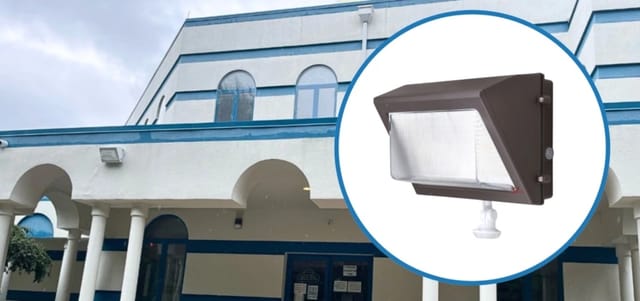
Exterior paths, parking areas, stairwells, and internal hallways require consistent visibility to keep people safe and comfortable. A motion sensor wall light gives office buildings a reliable way to brighten these areas only when needed. Clear lighting reduces slips, improves navigation, and supports building security after hours — IES RP-20 guidance for parking facilities calls for 1 to 5 footcandles average maintained illuminance on the parking surface, and even brief dark intervals create liability exposure. Good visibility also shapes the first impression of a commercial property, especially in shared spaces used by employees and visitors throughout the day.
LED Motion Sensor Wall Light Installation — LED Light Expert
Why Motion-Activated Wall Lights Are Becoming the Standard
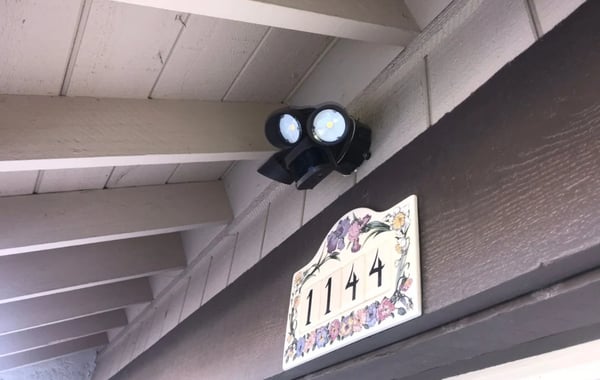
Motion sensor outdoor wall lights are now common across office buildings because they cut energy waste while improving overall safety. Traditional fixtures stay on even when a hallway or exterior walkway is empty, burning watts against an empty parking lot at 3 a.m. Motion activated options respond instantly to people approaching a space, saving electricity and reducing strain on the fixture — properly commissioned sensors respond quickly enough for normal entries, stairs, walkways, and loading zones.
LED technology, improved sensors, and customizable settings have made modern outdoor wall light fixtures with motion sensor controls far more accurate and reliable. This shift has made them a preferred choice for property managers working to reduce costs and maintain consistent lighting quality. Many current energy codes and project standards favor automatic shutoff, daylight response, and bi-level control for exterior lighting. A motion sensor wall pack with an integrated photocell is often a practical way to support those requirements, but the exact code path should be checked for the project location.
What Are Commercial Motion Sensor Wall Lights?
Definition and Key Components
A commercial
motion sensor wall light combines a weather rated LED fixture with a detection sensor that identifies movement in the coverage zone. The fixture itself includes the LED module, a die-cast aluminum or polycarbonate housing rated IP65 or higher per IEC 60529, a tempered or impact-resistant lens, a UL 8750 listed driver, and the occupancy sensor assembly — all wired to operate from a single 120–277V or 277–480V input.
PIR sensors read heat signatures from people or vehicles moving across the detection field. They use a pyroelectric element behind a segmented Fresnel lens to divide the scene into detection zones, then trigger when a warm body crosses from one zone to the next. PIR is the dominant sensor type in commercial wall packs because it resists false triggers from wind, rain, and nearby traffic.
Microwave sensors use low energy waves — typically 5.8 GHz Doppler, FCC Part 15 compliant — to sense motion, often with wider reach and the ability to detect around certain obstacles. Microwave detection ignores thermal clutter and works through lightweight glass or plastic walls, which makes it useful for enclosed stairwells, parking garages, and any area where a PIR sensor’s line of sight is compromised.
Many motion sensor outdoor wall lights include adjustable time delays (typically 30 seconds to 30 minutes), sensitivity controls (to tune out wind-blown debris or small animals), and daylight sensing to keep the fixture off during bright conditions. The best commercial models expose these as dipswitch or rotary-dial adjustments on the fixture, not just preset factory values — field tuning is essential because no two sites have identical traffic patterns.
How Motion Detection Lighting Works
Motion detection lighting stays in a standby mode until the sensor recognizes movement. Once triggered, the LED source switches to full brightness within seconds — modern bi-level drivers handle the 0–10V or DALI dim-up transition in under one second so there is no visible flicker or step-change. After movement stops, the light remains on for the programmed delay time before powering down again or stepping back to a 10 to 30 percent standby level.
This provides automatic lighting control without requiring switches, schedules, or manual adjustments. It keeps high traffic points well lit while reducing energy usage in quiet periods. The combination of full-output on motion and low-standby between events is what the energy codes call bi-level control, and it is the single biggest reason a commercial motion sensor wall pack saves more energy than a simple on/off fixture.
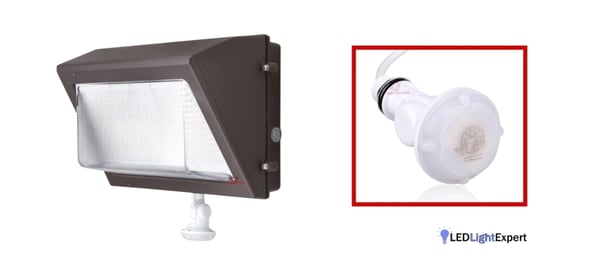
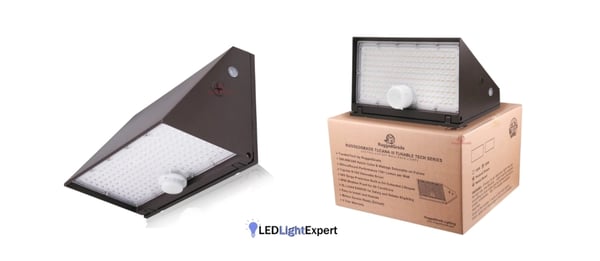
100W — Durado IV Series LED Wall Pack with Photocell + Motion Sensor
Benefits of Motion Sensor Wall Lights for Office Buildings
Energy Efficiency and Cost Savings
A motion sensor wall light supports energy reduction across large facilities by activating only when movement is detected. Traditional wall fixtures often run for hours without anyone using the space — a 100W wall pack running 12 hours a night, 365 nights a year, burns 438 kWh annually per fixture, and a typical multi-building office campus carries 40 to 80 of these on the exterior alone. Motion sensor outdoor wall lights cut unnecessary run time, which lowers utility bills and reduces strain on electrical systems. Actual savings depend on traffic patterns, standby level, time delay, fixture wattage, and commissioning quality.
For office buildings trying to manage multiple hallways, stairwells, exterior walkways, and parking areas, this targeted energy use makes a noticeable difference in long term operating costs. Some utilities offer rebates for qualifying DLC-listed fixtures or networked controls, but programs change often, so verify the current local incentive before quoting payback.
Improved Safety and Accident Prevention
Better visibility leads to fewer avoidable accidents. Stairways, dark corridors, and transitional areas inside commercial buildings benefit from a motion sensor wall light outdoor because it brightens the path immediately. Employees entering the space do not have to search for a switch or walk into a dim stairwell — Egress and stair lighting requirements are handled by the applicable building, fire, and life-safety codes, so motion settings must never leave required paths below the required light level during occupancy.
These fixtures also help guide people during power saving hours or late night access. Good lighting is one of the most effective ways to reduce slips, falls, and missteps in high traffic environments. From a workplace-safety angle, walking-working surfaces and exit routes need enough light for people to move safely, so occupancy settings should be tested from the first step into the space.
Enhanced Security
Security is another major reason office properties invest in
security outdoor wall light fixtures with motion sensor technology. Sudden illumination can deter trespassers, discourage loitering, and make it easier for security teams to monitor activity around the perimeter. Activity-responsive lighting can support a broader security plan because the change from standby to full output draws attention and improves camera visibility.
Parking areas, entrances, and loading zones stay dark until motion is detected, which makes unwanted activity more noticeable. Pairing these fixtures with the surveillance camera network amplifies the effect — a CRI 80+ LED wall pack lifts facial recognition and license-plate readability in recorded footage, which is what turns a security incident into actionable evidence rather than a blurry thermal blob.
Reduced Maintenance
LED fixtures already tend to need less routine lamp maintenance than older lighting technologies. Adding a motion sensor can reduce total operating hours, which may reduce driver, LED, and lens stress over time. Actual service life still depends on heat, driver quality, surge exposure, weather sealing, cleaning, and how the fixture is commissioned.
Maintenance teams spend less time replacing bulbs or troubleshooting fixtures that have been running nonstop. This is especially useful for lights installed in high or hard to access areas — loading dock canopies, second-story stairwell exits, and perimeter walls often require a scissor lift or boom truck for service, and every skipped truck-roll saves $200 to $600 in labor and equipment time.
Hands-Free Convenience
Motion sensor outdoor wall lights remove the need for switches, timers, or manual controls. People walk through a space and the light activates automatically. This helps in busy areas where people carry items, open doors, or move between rooms quickly — the hands-free behavior also meets the ADA Section 4.27.4 operable-parts guideline that interior illumination should not require a user action to reach code-minimum levels on entry.
Shared office corridors, stairwells, restrooms, copy rooms, and break areas all benefit from hands free lighting. It creates a smoother flow through the building while supporting energy efficiency. Smart controls layered on top can log occupancy data for space-utilization studies, which is increasingly valuable for post-pandemic office planning where real-use patterns drive HVAC, cleaning, and real-estate decisions.
Types of Motion Sensors and Activation Technology
PIR (Passive Infrared) Sensors
PIR sensors detect changes in heat from people or vehicles entering the detection zone. They are reliable, accurate, and widely used in most commercial motion sensor outdoor wall lights. PIR sensors work best in areas where movement happens across the field of view, such as hallways, stairwells, and building entrances — the Fresnel-lens array that covers the pyroelectric element creates 20 to 50 discrete detection segments, and each transition between segments is what the sensor interprets as motion. Typical PIR detection range on a wall pack is 20 to 40 feet at an 8 to 12 foot mounting height with a 180-degree coverage angle.
PIR performs well in cold and wet weather because it looks at thermal contrast rather than reflected energy, so blowing rain and snow rarely produce false triggers. Its main weakness is line-of-sight — a sign post, HVAC condenser, or parked delivery truck can create a blind spot that forces specification of a second fixture to cover the gap.
Microwave Sensors
Microwave sensors send out low energy waves that bounce back when movement occurs. They can detect through certain materials and cover larger spaces, which makes them effective for big open areas or spots where movement may occur around corners. A motion sensor wall light using microwave technology offers greater sensitivity, but it also requires proper placement to avoid false triggers in very active environments — adjacent HVAC airflow, vehicle traffic on a nearby road, or vibrating metal wall panels can all feed false motion events into a high-sensitivity microwave unit.
Commercial microwave modules run at 5.8 GHz under FCC Part 15, deliver 40 to 60 foot detection range on a wall pack, and cover a tunable 120 to 360-degree field. Good commercial fixtures let the installer dial sensitivity from 20 percent to 100 percent plus set a hold time, and the best ones mask out specific sectors through a lens shield or digital zone exclusion.
Photocell and Motion Combo
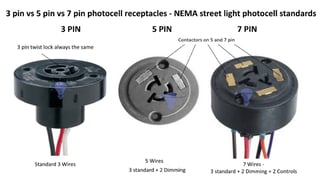
Many outdoor wall light fixtures with motion sensor features include a built in photocell. The photocell controls dusk to dawn operation, keeping the fixture off during the day and active only at night. Once it gets dark, the motion sensor takes over — a typical switch-on threshold is 1 to 5 lux ambient, which aligns with civil twilight, and the hysteresis band keeps the fixture from hunting when a passing cloud briefly dims the sky. This pairing is useful for exterior walls, walkways, parking areas, and any location that does not need lighting during daylight hours.
The photocell layer is what prevents unnecessary daytime operation. A timer alone can drift against seasonal sunrise and sunset changes, while a photocell reads actual daylight. Photocell plus motion control gives the fixture a simple way to stay off during the day, brighten when needed at night, and return to standby when the area is empty.
Smart Integrated Sensors
Modern LED fixtures often combine sensors with smart controls. These systems adjust brightness based on occupancy levels. For example, the light may run at a low standby brightness and shift to full output only when someone approaches. This gives you the benefits of a motion sensor wall light while maintaining minimal background illumination — the standby setting can be programmed as a percent of full output (commonly 20 to 30 percent) or as a target lumen value, and the step-up transition can be set anywhere from instant to a soft 1 to 3 second fade.
Smart controls create a balanced approach to visibility and energy savings in offices and large commercial facilities. DLC-qualified Networked Lighting Controls (NLC) extend this further by tying wall packs into a Bluetooth mesh or 0-10V / DALI network, which lets facility managers set schedules, log occupancy, adjust sensitivity, and push firmware updates from a central dashboard without pulling ladders.
120W — Tucana III TunableTech Series LED Wall Pack Light With Photocell & Motion Sensor
Where to Install Motion Sensor Wall Lights in Commercial Facilities
Parking Garages and Loading Docks
Parking garages and
loading docks see constant but unpredictable movement. A motion sensor outdoor wall light can brighten these areas as vehicles or people approach, improving visibility without running at full power all day. IES RP-20 calls for 1 to 5 footcandles average maintained on parking surfaces with a max-to-min uniformity ratio of 20:1 or better, and a bi-level wall pack that holds 1 fc at standby and steps to 5 fc on motion hits both targets with a fraction of the connected load of a full-output-all-night design.
These spaces often include blind corners, tight turns, and wide open sections that need consistent lighting. Motion activated fixtures reduce dark spots and help drivers navigate safely while lowering overall energy use. Loading docks specifically benefit from IK08 or IK10 impact-rated housings because forklifts, pallet jacks, and shifting cargo routinely strike wall-mounted fixtures.
Pathways and Entry Doors
Walkways that guide employees and visitors to building entrances benefit from outdoor wall light fixtures with motion sensor technology. Lights switch on as soon as someone walks within range, creating a clear path toward entry doors. This helps after hours, during early morning arrivals, or on days with low sunlight. Entry points also become safer, since the lighting responds instantly rather than relying on preset schedules — scheduled circuits always miss the first arrival of the day and the last departure at night, which are the two moments where illumination matters most.
A common design approach is to pair a primary wall pack above the door with a lower-mounted downlight or two along the approach path. The approach fixtures trigger the door fixture through a shared motion signal on a DLC NLC network, so the entire path lights up a few seconds before the employee reaches the entry.
Perimeter Security Walls
Many commercial buildings place
security fixtures along perimeter walls to strengthen security and visibility. A motion sensor wall light outdoor supports this by activating only when there is activity near the building’s edge. Sudden illumination can alert security staff and discourage trespassing. These fixtures work well along fences, back alleys, and external walls that are not frequently used but still need protective lighting.
Best practice on a perimeter wall is to mix microwave and PIR — microwave covers the broad sweep outward and catches movement through light vegetation or chain-link, while PIR fills in the near-wall zone where thermal signatures are clearest. Motion events on perimeter fixtures should log to the building management system so security personnel see a timeline of where activity occurred.
Stairwells and Emergency Exits
Stairwells are high risk areas if lighting is poor. Installing a motion sensor wall light helps each step become visible as someone enters the space. Emergency exits need special care because required egress paths must remain reliable for immediate use. Do not set standby levels so low that required paths fall below the applicable building, fire, or life-safety requirements during occupancy.
Pair the motion sensor wall pack with a UL 924 emergency backup driver for any stairwell that doubles as an egress path. The emergency driver forces the fixture to full output during a power loss for 90 minutes minimum, regardless of sensor state — the motion sensor reverts to its dark-standby behavior only when utility power returns.
Hallways and Break Rooms
Office hallways often experience inconsistent foot traffic. A motion sensor outdoor wall light activates only when someone walks by, which keeps the path bright without wasting energy. Break rooms also benefit because people step in and out throughout the day. Automatic lighting makes these areas easy to access while maintaining comfortable visibility. A 15-minute time delay with bi-level standby at 20 percent output is typical for these interior zones — long enough that someone lingering over coffee stays in full light, short enough that an empty room drops to standby within a reasonable window.
Restrooms and Storage Areas
Restrooms are frequently used but often left with lights running even when empty. Motion sensor wall lights help by turning lights on when someone enters and reducing output or shutting off when the space is vacant. Storage rooms, supply closets, and maintenance areas also work well with occupancy sensing because employees may enter briefly to grab equipment or supplies. Always match timeout and shutoff behavior to the local energy code and the room use.
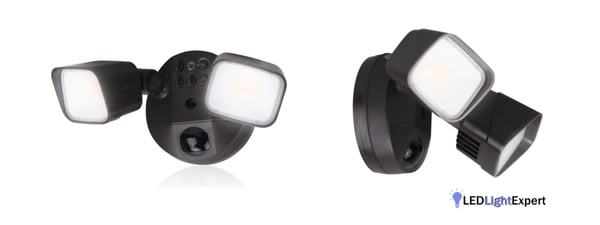
25W — LED Security Light with Photocell + Motion Sensor — Noctara Series — 2,250 Lumens
What to Consider When Choosing Motion Sensor Wall Lights
Sensor Range and Detection Angle
The coverage area of the sensor determines how well the fixture responds to movement. A motion sensor wall light should match the size and layout of the space. Wider detection angles work well for hallways and open areas, while longer ranges are better for parking garages and exterior walkways. Choosing the right sensor pattern keeps the light responsive without missing activity or turning on too easily. As a starting point, a PIR unit at 10 foot mount height covers roughly a 20 to 30 foot radius at 180 degrees; a microwave unit at the same height covers 30 to 40 feet at 360 degrees — walk every zone during commissioning and adjust the dipswitches until the coverage matches real foot-traffic paths.
Mounting Height and Location
Mounting height has a direct impact on detection accuracy. Installing the fixture too high or too close to obstructions can lead to missed movement or false triggers. A motion sensor outdoor wall light performs best when mounted at an appropriate height with a clear line of sight. Avoid placing sensors behind pillars, large equipment, or corners that block movement. Proper placement keeps the fixture reliable and reduces unnecessary activations. Standard mounting for exterior commercial wall packs runs 8 to 12 feet AFG (above finished grade); going higher than 15 feet shrinks the PIR footprint dramatically, and going below 8 feet raises the false-trigger rate from passing people and pets.
Weatherproof and Durable Construction
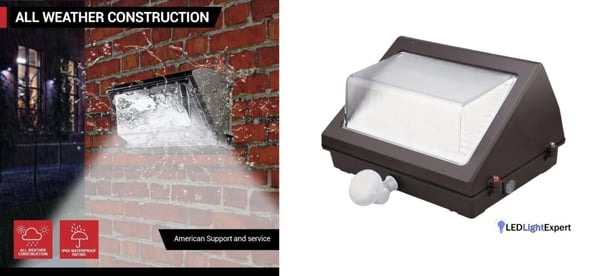
For exterior applications, durability matters. Outdoor wall light fixtures with motion sensor controls should include a high IP rating to handle rain, dust, and humidity. IP65 or higher is a common standard for commercial exteriors. Impact resistance, measured with an
IK impact rating, is also helpful in garages or high traffic areas where equipment or vehicles may pass close to the fixture. Durable construction extends the life of the system and reduces maintenance costs.
For coastal sites, specify a salt-spray tested housing — ASTM B117 at 500 to 1000 hours is a reasonable floor, and marine-grade powder-coat finishes on die-cast aluminum bodies are what hold up after five or ten years within two miles of salt water.
Outdoor wall light fixtures with motion sensor controls should include a high IP rating to handle rain, dust, and humidity.
Brightness and Beam Spread
Different commercial spaces need different light levels. Parking areas, stairwells, and hallways usually require clear, even lighting. Lumens determine overall brightness, while beam spread shapes how that light distributes across the area. A motion sensor outdoor wall light with too narrow of a beam can create uneven lighting. Wider beam spreads provide better visibility and reduce shadows along walkways and building entrances. Type III and Type IV IES distributions are the standard for wall-pack work — Type III throws light forward and to the sides for perimeter walls, Type IV concentrates it forward for parking garage bays and loading dock doors.
Color Temperature Recommendations
Color temperature influences visibility, clarity, and comfort. Most commercial buildings choose 4000K to 5000K because these ranges offer a bright, neutral white appearance. This supports productivity and helps people see clearly during early mornings, evenings, or low light situations. Warmer temperatures can make areas look dim or yellow, which is not ideal for workplaces. Keep CRI at 70 minimum and target 80+ wherever security cameras rely on color detail — the difference between Ra 70 and Ra 80 is obvious on a recorded face or a vehicle paint color.
Dimmable and Bi-Level Lighting Options
Many modern fixtures include bi level lighting, which keeps the light at a low standby brightness until motion is detected. This is useful for code compliance, especially in stairwells or emergency egress routes that must maintain minimum lighting levels. Dimmable fixtures also offer a smooth transition between low and full brightness, creating a comfortable experience for employees without increasing energy use. Look for 0-10V dimming or DALI control as a minimum; these protocols are what integrate cleanly with a building management system and let future upgrades happen without rewiring.
Certifications and Safety Ratings
Quality certifications help verify performance and safety. UL listing supports electrical safety evaluation, while DLC qualification may matter for some utility incentive programs. Rebates and code requirements change by location and project type, so confirm the current program rules and local code before quoting incentives or compliance. Choosing properly listed fixtures gives the project a stronger starting point for review and long-term reliability.
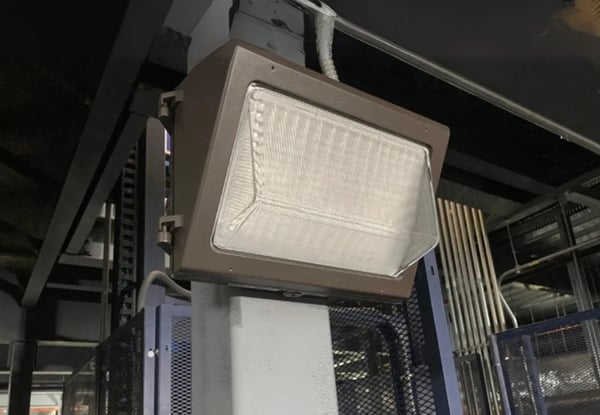
LED Motion Sensor Wall Light Example — LED Light Expert
Conclusion
Commercial motion sensor wall lights give office buildings a practical way to control lighting, improve visibility, and reduce unnecessary runtime. From stairwells to exterior entry points, these fixtures support safety, convenience, and long-term reliability. With multiple sensor technologies, beam options, and control settings, modern outdoor wall light fixtures with motion sensor features can be a strong part of efficient building design when they are commissioned carefully.
The right lighting system helps protect employees, guide visitors, and lower operational costs. Careful placement and selection create a safer environment without increasing workload for maintenance teams. As more companies upgrade their properties, motion activated LED wall lights are becoming a standard for both new construction and retrofits. Simple payback typically runs 2 to 5 years when utility rebates, maintenance savings, and reduced truck rolls are counted — after that, every additional year is net margin.
For commercial-grade motion sensor outdoor wall lights built for long-term performance, explore the full selection at
LEDLightExpert.com. Our lighting specialists can help you choose the right fixture, assist with layout planning, and answer technical questions on photometrics, controls, certifications, and current rebate documentation.






 Free Shipping
 Free Extended Warranty