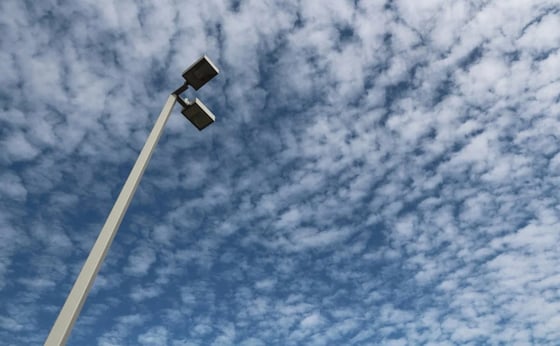
Light poles play a critical role in outdoor lighting systems, from highways and city streets to stadiums and parking lots. They provide safety, visibility, and security. But one issue that often goes unnoticed until it becomes serious is light pole vibration. While some movement in poles is expected, ongoing vibration can shorten the lifespan of the pole, compromise fixtures, and even create hazards for people nearby.
Understanding what causes light pole vibration and how it can be managed is key to keeping lighting systems reliable and safe. The American Association of State Highway and Transportation Officials (AASHTO LTS-6, Chapter 11) requires fatigue-category analysis for luminaire support structures in exposed roadway environments, and the underlying physics — wind loading, Strouhal vortex shedding, and harmonic resonance — apply equally to highway high-mast poles, parking lot standards, and bridge-mounted fixtures.
Light poles play a critical role in outdoor lighting systems, from highways and city streets to stadiums and parking lots.
Understanding Light Pole Vibration
In outdoor lighting, vibration refers to the repetitive movement of the pole structure caused by external forces like wind or nearby traffic. This isn't just a minor sway during a storm; it's a rhythmic oscillation that can happen day after day, even in conditions that don't seem extreme. For a typical 25-40 ft steel pole, the first-mode natural bending frequency falls in the 1-3 Hz range, which happens to align uncomfortably well with gust-driven wind loading and with vortex-shedding frequencies at common roadway wind speeds.
Not every bit of movement is problematic.
Light poles are designed to have some flexibility, and small shifts are normal. The concern arises when movement turns into a light pole harmonic vibration, where the natural frequency of the pole amplifies the effect of wind or traffic forces. That's when vibration becomes a structural issue rather than just a cosmetic one.
Over time, problematic vibrations can lead to serious damage:
Fatigue cracks in the pole material
Small cracks often start at welded joints, cutouts, or transitions in the pole where stress is concentrated — AASHTO LTS-6 classifies these as Category E' or E details, the lowest fatigue strength joints in the code. Each cycle of vibration forces these cracks to grow, even if the movement looks minor from the outside. Left unchecked, these hairline fractures spread through the steel or aluminum and eventually compromise the structural integrity of the entire pole.
Loose fixtures and hardware
Vibrations gradually work bolts, brackets, and luminaire mounts loose. A light fixture that shakes with every gust or truck passing by will eventually misalign, tilt, or stop functioning altogether. In severe cases, parts can detach completely, posing a safety hazard to drivers, pedestrians, or nearby property. Anchor bolts meeting ASTM F1554 Grade 55 or 105 and properly torqued per manufacturer spec with double-nut leveling hold up far better than undersized or misaligned hardware.
Complete pole failure
The combination of material fatigue and weakened connections can lead to sudden collapse. While rare, failures have occurred in highway medians, parking lots, and bridges. These incidents carry a heavy cost, not only in replacement and repairs but also in liability for accidents or injuries caused by falling poles or fixtures.
For cities, businesses, and facilities managers, ignoring vibration issues can mean costly repairs, liability risks, and premature replacement of poles. Addressing the causes early helps extend the life of lighting systems and ensures outdoor spaces remain safe and well-lit.
Light poles are designed to have some flexibility, and small shifts are normal.
Wind-Induced Vibration
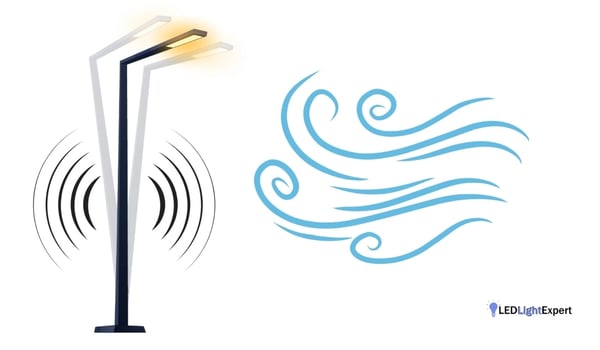
One of the leading causes of light pole vibration is wind. Even light breezes can put pressure on a pole, especially if it is tall and slender. Unlike a short, sturdy structure, a light pole offers little resistance to air movement. As
wind flows around the pole, it applies force that can set the pole in motion. Strong gusts amplify this effect, pushing and pulling until the pole oscillates. The Effective Projected Area (EPA) rating of the luminaire and bracket assembly — combined with the pole's wind zone classification under TIA-222 or AASHTO wind maps — dictates how much steady-state wind pressure the structure was engineered to absorb.
The surrounding environment also plays a major role. In wide open spaces such as highways or rural areas, there is nothing to break up wind flow. Poles here are exposed to direct gusts that can set off noticeable vibrations.
In contrast, poles in dense urban areas face turbulent wind. Buildings redirect air currents, creating unpredictable swirls and eddies. While turbulence can sometimes break up steady oscillations, it can also introduce erratic forces that stress the pole in different ways.
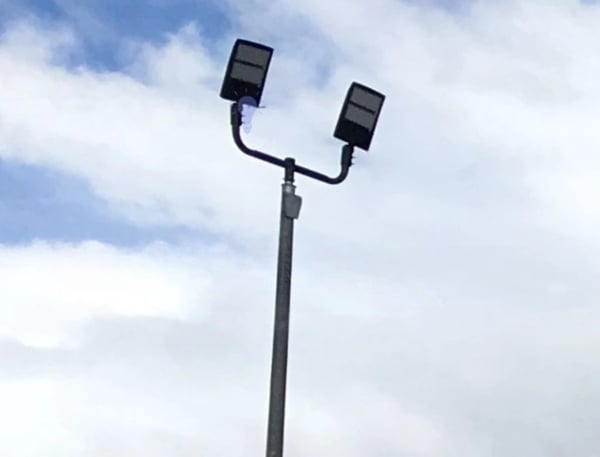
Design matters too. Tall, slender poles,
common in parking lots, roadways, and bridges, are much more susceptible to wind-induced vibration than shorter or wider ones. Their proportions make them act like flexible levers, magnifying the effect of wind — and the diameter-to-height slenderness ratio is the single strongest predictor of vibration susceptibility.
Poles in dense urban areas face turbulent wind. Buildings redirect air currents, creating unpredictable swirls and eddies.
Vortex Shedding and Its Impact
A specific type of wind-induced vibration that often affects lighting poles is vortex shedding. This phenomenon occurs when wind passes around a cylindrical object, such as a pole, and creates alternating low-pressure vortices on either side. These vortices shed in a rhythmic pattern at a frequency predicted by the Strouhal number (St ˜ 0.18-0.22 for round cylinders), pulling the pole side to side along an axis perpendicular to the wind direction.
Vortex shedding doesn't just cause minor swaying. Because the shedding happens at regular intervals, it can match the natural frequency of the pole, leading to light pole harmonic vibration — the lock-in condition where the pole's motion actually controls the shedding frequency and amplifies the response. When this resonance occurs, the oscillation grows stronger and more damaging over time.
Tall poles, especially those used for bridge or highway lighting, are particularly vulnerable. Their geometry and height make them ideal candidates for resonance when wind speeds hit certain ranges — typically 20-40 mph steady wind for standard 25-40 ft round or lightly tapered poles. For example, a steady wind at just the right velocity can trigger vibration cycles that repeat for hours, stressing the metal and its connections. A single afternoon of lock-in at 2 Hz produces more than 7,000 stress cycles.
This connection between wind speed, pole geometry, and harmonic resonance explains why some poles in the same area may vibrate while others remain stable. The difference often comes down to size, shape, and exposure — and is why tapered and multi-sided (octagonal, fluted) poles are specified in high-exposure installations to disrupt the regularity of vortex shedding.
Traffic-Induced Vibration
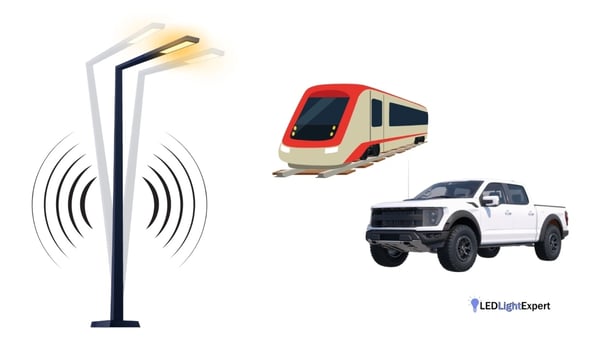
Traffic is another significant contributor to light pole vibration, especially in areas close to busy roads, railways, or construction zones. The movement of vehicles, particularly heavy trucks, sends vibrations through the ground that can travel into nearby poles. While these forces are not always visible above ground, the repeated stress adds up over time. Geotechnical studies typically measure truck-induced ground vibration at 5-25 Hz with peak particle velocities of 0.05-0.5 in/sec at 10-30 ft offset from the roadway edge.
Trains, with their weight and speed, can cause even stronger vibrations. The rhythmic passing of cars or trains creates a pulse that transfers into the soil, where it moves upward into pole foundations. Similarly, ongoing construction, pile driving, excavation, or heavy machinery produces ground vibrations that can destabilize poles nearby.
These vibrations may seem minor compared to wind-induced swaying, but the constant stress gradually loosens anchor bolts, shifts foundations, and causes fixtures to rattle. Over time, the cumulative impact increases the risk of structural fatigue and failure — particularly at the pole-to-base-plate weld, which is a Category E' fatigue detail under AASHTO LTS-6.
The rhythmic passing of cars or trains creates a pulse that transfers into the soil, where it moves upward into pole foundations.
Structural Factors
While wind, traffic, and nearby activity can all set a pole in motion, the structure of the pole itself often determines how severe the vibration becomes. The way a pole is designed, the material it's made from, and how it's installed at the site all play a critical role in whether it stands firm or struggles under stress.
Key Design Factors
- Pole height: The taller a pole is, the greater the leverage effect. Even a small force applied at the top creates significant movement at the base. This is why highway or stadium poles, which can extend 15 meters or more, experience stronger vibrations than short residential poles. Their height amplifies every gust of wind or passing truck, making them more susceptible to long-term fatigue — and shifts their first-mode natural frequency toward the lower end of the 1-3 Hz range, closer to common gust-pulse frequencies.
- Diameter and wall thickness: A pole's stiffness depends heavily on its diameter and wall thickness. Narrow poles with thin walls flex more easily, which makes them vulnerable to light pole harmonic vibration. In contrast, a wider or thicker pole is stiffer and resists bending. However, the trade-off is weight and cost, so engineers must balance strength with practicality. ASTM A595 Grade A steel with 7-gauge (0.179") or thicker wall is a common specification for exposed roadway poles.
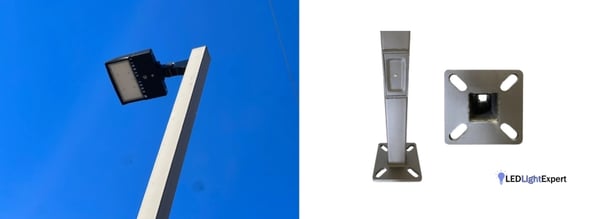
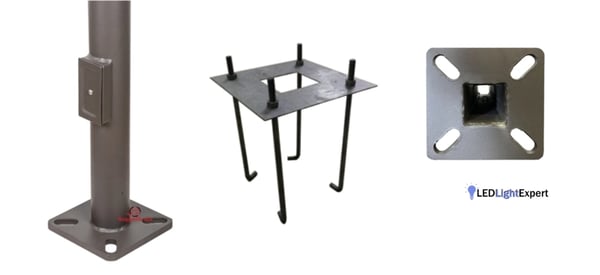
- Mounting style: How a pole is anchored to the ground is just as important as the pole itself. Direct-buried poles, where the base is set directly in soil or concrete, transfer forces differently than poles bolted onto an anchor base. If anchor bolts are undersized, misaligned, or improperly tightened, the connection becomes the weak point. Vibrations that might otherwise be absorbed are instead magnified at the base, leading to cracks or premature failure.
Installation Quality and Foundations
The installation process is often the hidden variable in vibration problems. A well-designed pole can fail prematurely if it's not installed correctly. Common issues include:
- Undersized bases that don't provide enough mass to resist ground-transmitted vibrations.
- Poor soil conditions, such as sandy or unstable ground, which allow excessive movement at the foundation.
- Incorrect alignment, where poles lean slightly or are not properly centered, increasing uneven stress points.
- Under-torqued or un-grouted anchor bolts — double-nut leveling with a verified torque-to-yield sequence is the standard for fatigue-resistant base connections.
When these factors combine, a pole becomes unstable even under ordinary conditions. What appears to be a vibration issue caused by wind or traffic is often traced back to a base that was never equipped to handle real-world forces.
In short, the pole's design and foundation form the first line of defense against vibration. Investing in stronger materials, properly engineered bases, and careful installation reduces the likelihood of future failures and extends the working life of lighting systems.
10 Foot Steel Light Pole - 3 inch Round Tube Light Pole - LED Light Expert
Harmonic Vibrations
A particularly dangerous form of lighting pole vibration is harmonic vibration. This happens when external forces, such as wind, traffic, or even nearby machinery, match the pole's natural frequency. At that point, the pole begins to resonate, and the result is far more destructive than ordinary movement. Resonance dramatically reduces the structural damping effect — poles typically exhibit only 0.3-0.7% critical damping, meaning small forcing inputs produce large amplified responses if the frequencies align.
The resonance effect means that small, consistent forces can create large oscillations. A light breeze or the rhythmic passing of trucks may not seem powerful, but if their frequency aligns with the pole's own, the vibration intensifies dramatically.
An easy way to understand this is by comparing it to a tuning fork. Strike the fork, and it vibrates at its natural pitch. A light pole behaves the same way; when the external force lines up with its natural frequency, the structure vibrates strongly, even if the original force is modest.
This is especially problematic for long poles with uniform cross-sections, such as those commonly used along highways or in
bridge lighting. Without variation in shape or added structural reinforcements, these poles are more likely to resonate under the right conditions, leading to light pole harmonic vibration that can quickly weaken the structure. This is why modern spec sheets call out multi-sided (octagonal or fluted) and tapered profiles specifically — the geometric variation interrupts the coherent vortex street before it can lock in.
Poles with higher structural strength are less likely to flex excessively under environmental stress.
Preventing and Managing Light Pole Vibrations
While vibration is a persistent issue, there are proven ways to prevent and manage it effectively.
Design Solutions
Engineers often incorporate features that reduce vibration risk, such as tapered poles, which break up airflow and reduce the likelihood of resonance.
Light pole vibration dampers can also be installed. Two common options are tuned mass dampers (TMDs), an internal spring-mass element tuned to the pole's first-mode natural frequency, and Stockbridge dampers, weighted loops hung from the pole top that are tuned to the dominant vortex-shedding frequency. Both options can cut steady-state vibration amplitudes 60-80%. Stiffeners inside the pole can add rigidity and limit excessive movement at the base-plate weld region.
Material Considerations
Using stronger alloys and thicker walls helps increase resistance to fatigue. Poles with higher structural strength are less likely to flex excessively under environmental stress. While this may add to the upfront cost, it reduces long-term maintenance and replacement needs. ASTM A595 Grade A steel at 7-gauge wall thickness remains the workhorse spec for roadway standards; galvanizing per ASTM A123 protects against corrosion fatigue, which can dramatically accelerate crack propagation at welded joints.
Placement Strategies
Where poles are installed is just as important as how they are built. Avoiding wind corridors—narrow pathways where air speeds up—and minimizing placement near heavy traffic or rail lines can lower exposure to vibration-inducing forces. Strategic siting is one of the simplest ways to reduce long-term risks.
Inspection and Maintenance
Even the best-designed poles are not immune to wear. Regular inspections are essential to catch early signs of fatigue, such as cracks, loose fixtures, or unusual sway. AASHTO LTS-6 and most DOT maintenance manuals recommend annual visual inspections plus 5-7 year detailed structural inspections that include anchor-bolt torque verification, ultrasonic weld inspection at the base-plate connection, and hand-hole crack surveys. Preventative maintenance extends the lifespan of poles and protects surrounding areas from potential hazards.
"An ounce of prevention is worth a pound of cure." - This principle applies strongly to outdoor lighting systems. Early action saves money, prevents accidents, and keeps communities safe.
Conclusion
Light pole vibration is more than a minor annoyance. Left unchecked, it leads to structural fatigue, fixture damage, and eventual failure. The causes are varied; wind, traffic, structural design, and harmonic resonance all play a role, but the solutions are clear.
By understanding how light pole harmonic vibration develops, recognizing the impact of vortex shedding, and accounting for environmental and structural factors, decision-makers can extend the life of their lighting systems. Tools like the light pole vibration damper, along with thoughtful design per AASHTO LTS-6 and routine inspections, provide practical ways to manage this risk.
Lighting poles are critical infrastructure, and their reliability affects safety on roads, bridges, and public spaces. Addressing vibration isn't just about protecting equipment; it's about ensuring that outdoor lighting systems continue to perform their essential role every day. Our full catalog of
parking lot light poles and mounting hardware spans ASTM A595 steel configurations in round, square, and octagonal profiles with matching EPA-rated brackets — or
contact our lighting specialists for pole and foundation recommendations tailored to your wind zone and traffic exposure. Learn more
about LED Light Expert and our 30+ years of lighting expertise.
A good decision on light pole vibration starts with the real installation conditions, not just the product name. Check the application, mounting height, voltage, light level, glare, controls, wet or dust exposure, service access, and whether a photometric layout or qualified installer is needed before ordering.





 Free Shipping
 Free Extended Warranty