


For a typical IEC-colored single-phase LED fixture, brown means line or live, blue means neutral, and green-yellow means protective earth/ground. On a common US 120V circuit, that usually maps to brown-to-black, blue-to-white, and green-yellow-to-green or bare ground. Do not rely on color alone: turn power off at the breaker, confirm the conductors with a meter, follow the fixture wiring label, and use a licensed electrician for unfamiliar or higher-voltage circuits.
Brown, Blue, and Green-Yellow Wire Meanings
Many LED fixtures sold in the United States use international IEC wire colors instead of the familiar US black, white, and green. That can be confusing when you open a fixture and see brown, blue, and green with a yellow stripe. The colors are not random; they identify the fixture's incoming AC conductors.
The important safety rule is this: wire color is a guide, not proof. Imported fixtures, replacement cords, prior repairs, and local wiring practices can all create exceptions. Before making any connection, read the fixture label, verify voltage, and identify the supply conductors with a tester.
Common IEC-to-US Color Mapping
| Fixture Wire Color | IEC Meaning | Common US 120V Match | Safety Note |
|---|---|---|---|
| Brown | Line, live, or hot | Black hot conductor | Verify it is the switched or unswitched hot required by the fixture. |
| Blue | Neutral | White or gray neutral conductor | Blue is neutral in IEC AC wiring, not DC negative. |
| Green-yellow | Protective earth | Green, green-yellow, or bare copper ground | Never use the ground as a current-carrying neutral. |
How This Applies to LED Fixtures
For a straightforward 120V installation, a brown/blue/green-yellow LED fixture usually connects brown to the building hot, blue to neutral, and green-yellow to the equipment grounding conductor. That is common on LED wall packs, flood lights, high bays, and other fixtures built with international color leads.
Higher-voltage installations deserve more care. A fixture may be rated 120-277V, 277-480V, or another range, and the supply may be single-phase, split-phase, or three-phase. In those cases, do not assume the 120V color mapping. Follow the wiring diagram on the driver or fixture label and local code. When a fixture has a label such as L, N, PE, DIM+, DIM-, or 0-10V, those markings matter more than the jacket color.
Before You Connect Anything
- Turn power off at the breaker, not only at the wall switch.
- Confirm the fixture voltage rating matches the circuit.
- Use a meter or voltage tester to identify hot, neutral, and ground.
- Keep grounding continuous and secure; do not cut off the ground conductor.
- Use listed connectors and strain reliefs appropriate for the fixture and environment.
- Stop and call an electrician if the box has multiple circuits, no clear ground, unusual voltage, damaged insulation, aluminum wiring, or no wiring diagram.
Color Codes Are Helpful, but Testing Is Safer
US electrical rules reserve white or gray for grounded neutral conductors and green, green-yellow, or bare copper for grounding conductors. Hot conductor colors can vary by system and local practice. That is why a safe installer treats color as the first clue, then verifies with the fixture label and a tester.
If the fixture is not safety listed, lacks a wiring diagram, or uses colors that do not match the label, do not guess. A lighting fixture can still illuminate when wired incorrectly, but poor grounding, wrong voltage, or reversed conductors can create shock, fire, warranty, and insurance problems.
Wiring Color Code FAQs
More Details to Consider
. Here is a question that we get: Brown Wire, Blue Wire and Green Stripe Wire - what are these? Which is black and hot and which is white? If you are reading this, chances are you recently purchased a light fixture such as an LED Parking Lot Light or Warehouse lighting and are trying to install it in the USA. (Usually it's junk, but we'll get to that.) The light is just using international wiring standards. As if meters and feet or liters and gallons were not bad enough, we now have wiring differences.
Brown, blue and green stripe wiring is actually more common around the world than our black, white and green. Most commercial fixtures such as LED wall packs and LED high bay lights use the standard USA color codes of Black, White and Green. Even our residential lights use the black, white and green colors. If you bought a cheap light with international colors and no safety certification, chances are high that it won't last. Also keep in mind that you won't have insurance and are liable for any damages it causes. Our lights are UL
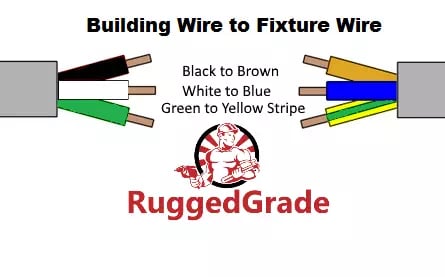
safety rated and we have full liability insurance. We get audited every year to make sure we are only buying and selling safe reliable lights. If you do have a fixture using international standards, the good news is that the matching is very easy. Brown is your hot wire so you want to connect that to your building's black wire. The blue is the neutral or return, so that will go to white. Green with yellow stripe is the ground and will go to the building green. The quick reference: brown to black, blue to white, green-with-yellow-stripe to green.
If you are running 240 volts or more then you will probably have multiple hot wires connecting to the fixture's brown wire and Blue Wire. Remember that you should only run higher voltage if you have to. Most new LED Lights do not require that much power and 120v is fine. The only real reason anymore is for very long runs, such as sending wiring 200 plus feet out for Sport Court Lighting or where the building is already wired for 480vac and you have to keep it. See attached image
for the visual version of the wiring guide. Remember to always kill power at the breaker, not just the switch. Always secure your connections with proper wire nuts or other connectors. Safety first.
Frequently Asked Questions
- What do brown, blue, and green-yellow wires mean?
- In common IEC single-phase wiring, brown is line or live, blue is neutral, and green-yellow is protective earth or ground. In common US 120V wiring, black is hot, white or gray is neutral, and green, green-yellow, or bare copper is ground.
- Can I connect brown to black, blue to white, and green-yellow to green?
- That is the usual mapping for a simple 120V US branch circuit feeding an IEC-colored fixture, but color alone is not enough. Always follow the fixture label, verify conductors with a meter, turn power off at the breaker, and use a licensed electrician when the circuit is unfamiliar.
- Is blue negative in AC wiring?
- No. In IEC AC wiring, blue normally identifies neutral, not negative. Negative is DC terminology. LED fixtures may contain DC drivers internally, but the building-side AC input should be described as line, neutral, and ground unless the product label says otherwise.
- What if the LED fixture is 208V, 240V, 277V, or 480V?
- Do not assume the same 120V color mapping. Higher-voltage and multi-phase systems can use different hot conductor colors, and some fixtures accept line-to-line input. Confirm the fixture voltage range, wiring diagram, and local code before connecting.
Related Articles
Ready to Upgrade Your LED Lights?
Our lighting specialists can help you match listed fixtures, drivers, and controls to your project.
Monday–Friday, 8am–5pm PST

About the Author
Dara Greaney is founder and CEO of LED Light Expert with deep expertise in LED fixtures and light design. LinkedIn · X (Twitter)
Editing by David Peguero
14 Comments
R Busby
I have an LED with two clear wires (one has lettering on the wire) and according to poor instructions this should be wire that attaches to our white common wire. The othere I have to assume attaches to the U.S. black or hot wire. This does not work nor does the reverse wiring. Should I just throw it away?
rick
Throw it away! Not one of ours! Ours will always be 3 wire, grounding it is a required safety precaution. Ours are also easier to install with standard wiring colors.
Danny longest
What are the brown wire is it hot or grown and the black wire to put a new light up
bill
hi I need help, I got led Outdoor Motion Sensor Lights need to replace the PIR Human Body Motion Sensor Detector . the led Outdoor Motion Sensor Lights come with black, white and yellow green wire vs sensor detector come with red, blue and looks like brown color wire. can u ple tell me how to connect to each other? Thank a lot!!!
EDWARD
HELP! I am writing from Italy, where I recently purchased a "DuraLamp" LED light fixture and bulb for a small vestibule in my basement, separating it from the underground garage. The fixture is pretty straightforward with one BROWN and one BLUE wire coming out of it. I connected the corresponding BROWN and BLUE and capped off the GREEN-YELLOW (earth or ground) wire coming from my home. All this done, I hung the light and voila, It worked...but when I turned off the lamp, the bulb permanently stayed very dimly lit. While I can live with it, I know it isn't supposed to do this. Might anyone have some suggestions?
Rick R.
Edward, We recommend you get in contact with the manufacturer of the fixture for troubleshooting help. If you are looking to replace the fixture completely, please feel free to contact us at 800-674-9420 or via email at [email protected]. Thanks, Rick R.
Jim G.
Hi - I purchased a light fixture that has Brown and Blue wiring only and I want to connect to the housing wiring which is Black, White and copper/ground. What color wiring to I connect together?
Rick R.
Jim, All of our fixtures have ground wires included. If you purchased a light elsewhere that did not have a ground, I would be very wary about using it. Colors would normally be brown to black and blue to white, but I would check with the manufacturer of the fixture you purchased to be sure since we do not know anything about the fixture.
Darryl Correya
Hey guys, I have a chandelier with a brown wire within which there are two wires which I presume are the hot and neutral ones. Trouble is they both have the same brown colour which makes it impossible to tell which is which. Can anybody help me identify the two? Thanks Darryl
Rick
Darryl, Our expert customer service team would be more than happy to assist you if this was regarding one of our products that they've been trained on. Unfortunately we're not able to provide support for someone else's product. You may have to get assistance from an electrician to identify the proper ground wire for your application.
Chalmos N Alday
Howdy: Approximately two years ago, I installed five new 110v, 2-tube 4-feet long, T8 fluorescent fixtures having "electronic" ballasts, in a series line (ballasts for each of the five fixtures are wired in parallel to the line) in my residential garage. One year ago, I removed the T8 fluorescent tubes and replaced them with LED tubes. They all worked beautifully until approximately one month ago, when three of the five fixtures "went dark." I replaced the LED tubes w/new tubes of the same type. No illumination resulted. I then replaced those LED tubes with T8 fluorescent tubes. Same result; no illumination. Without putting a test meter on the circuits, I conclude the three electronic ballasts are "bad." What do you suggest I do to correct this problem, rather than removing and replacing my current fixtures? How should I "wire around the ballasts," as I am reading in quite a number of internet posts to influence my LED tubes to work as designed? Or, what should I do to, as you indicate, replace the ballasts with "drivers?" Thanks for your timely communications and guidance. I look forward to hearing from you.
Rick
Get rid of the ballasts. LEDs do not use ballasts and they are only leading to higher power usage and short life on the LEDs. T8 LED tubes can be purchased as ballast compatible, but we always recommend staying away from that option as you are just delaying the inevitable. Go with a type B or type A+B T8 LED tube with an internal driver and do away with those ballasts.
Mykah
I have a light with blue brown green and I’m purchasing a led driver for this why don’t a led driver have ground connection where does ground from light go ?
Juan
The lights from the driver to the panel are DC, not AC and therefore do not have a ground. LEDs actually require constant current and run off of DC power.
larry
I am replacing an LED ballast/driver on an outside sign and to no avail. How can I test the light itself to be sure of the condition of the light itself.
Rick
Hard to tell you without knowing more about the product. Simple answer is confirm input and output voltage to and from the driver and make sure that matches up to the specs on the product. You may just have to replace the fixture as a whole and if you need help with a replacement, give us a call 1-800-674-9420
Kenny Russo
220 volt tankless water heater -brown , blue , yellow with green stripe which 2 of these wires should I put 110 volts to and which wire is the ground wire ? Thanks
Sales
Thanks for reaching out, Follow the color diagram on the article, Please feel free to reach out to us directly at 800-674-9420 or [email protected] for pricing/quotes or product info at any time
Daniel
Hello I have what I’m sure is a 15” 11 LED waterproof trailer tail light. The wires however are black white and green like an AC light would be. Is it possible that the Chinese (I’m assuming) manufacturer used the North American AC wiring code for their choice in wire colours as I can’t get them to work properly
Sales
"Thanks for reaching out, try Hot (Black) to Hot(Source Power), Neutral (White) to Neutral(Source Power), and Ground (Green or Green and Yellow) to Gound (Source Power) Please feel free to reach out to us directly at 800-674-9420 or [email protected] for pricing/quotes or product info at any time."
Bobby
Thank you for the information I was lost trying to wire an old fixture
Sales
Thanks for reaching out. Please feel free to reach out to us directly at 800-674-9420 or [email protected] for pricing/quotes or product info at any time
Vic
Thanks for the help on this retrofit, I had no idea what to do, just followed the diagram it was that easy
Sales
Thank you for reaching out. Please feel free to contact us directly at 800-674-9420 or [email protected] for pricing/quotes, or product information at any time.
this product is nifty.
this product is nifty.


