

Quick Answer
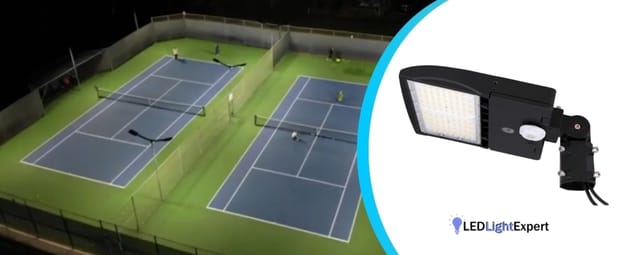
For most tennis courts, choose LED sports lights by target lux, uniformity, glare control, pole height, beam angle, and weather rating. Recreational courts commonly need about 300 lux, while higher-level play may require 500 lux or more with tighter uniformity. A photometric layout is the safest way to confirm pole count, aiming, spill control, and fixture wattage before purchase.
LED Tennis Court Lights and Their Advantages
LED tennis court lights have revolutionized the way we illuminate our courts. Unlike traditional lighting solutions, LEDs (Light Emitting Diodes) offer numerous benefits that make them the preferred choice for modern tennis court lighting design. Here’s why LED lighting is essential for enhancing visibility and player performance:
What are LED Tennis Court Lights?
LED tennis court lights are specialized lighting fixtures designed specifically to illuminate tennis courts. These lights use LED technology, which involves semiconductors that emit light when an electric current passes through them. Unlike traditional lighting sources such as halogen or metal halide, LEDs are more efficient, durable, and offer superior light quality.
Importance of LED Lighting in Enhancing Visibility and Player Performance
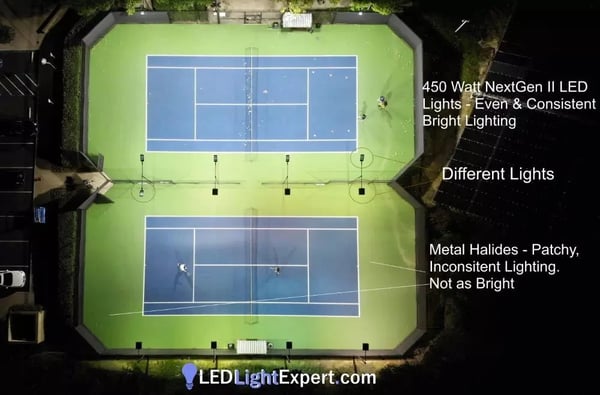
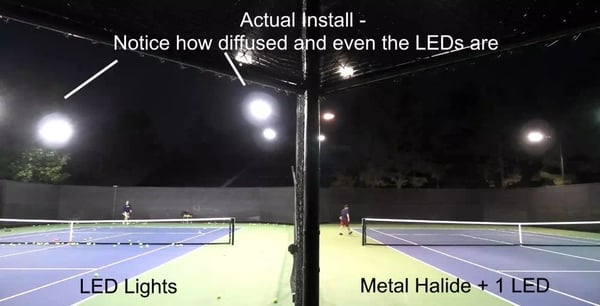
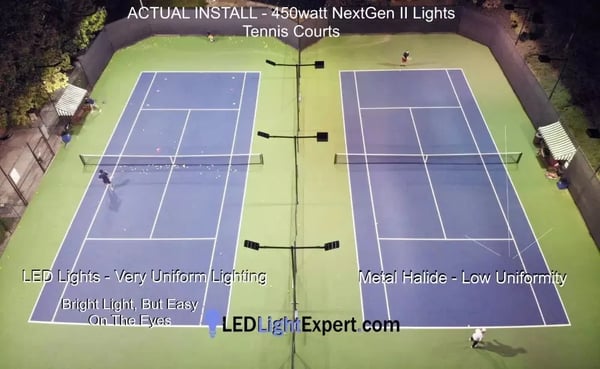
- Superior Illumination: LED tennis court lights provide brighter and more uniform lighting compared to traditional lighting systems. This uniformity ensures that there are no dark spots or overly bright areas, providing consistent visibility across the entire court. Players can see the ball clearly, track its movement accurately, and react promptly, enhancing overall game performance.
- Energy Efficiency: LEDs consume significantly less power than traditional lights, making them an energy-efficient choice. This reduction in energy consumption not only lowers electricity bills but also reduces the environmental impact, aligning with sustainable practices.
- Longevity and Durability: High Quality LED lights have a longer lifespan, often lasting up to 100,000 hours or more. This durability means less frequent replacements and lower maintenance costs. Additionally, LEDs are more robust and resistant to damage from impacts or vibrations, which is crucial for outdoor installations like tennis courts.
- Instant Lighting: Unlike traditional lights that may take several minutes to reach full brightness, LED lights turn on instantly. This feature is particularly beneficial for evening games or tournaments, where immediate and reliable lighting is necessary.
- Reduced Glare and Light Pollution: LED lights are designed to minimize glare, ensuring that players are not blinded by bright light during crucial moments. Furthermore, they can be directed precisely where needed, reducing light spill and pollution, which is considerate of neighboring properties and the environment.
- Customizable Lighting Design: LED tennis court lighting design allows for customization to meet specific needs. Whether it’s adjusting the brightness, color temperature, or the layout of the lights, LED systems provide flexibility to create the perfect lighting conditions for any court.
LED tennis court lights are a game-changer for modern tennis courts. Their superior illumination, energy efficiency, longevity, and customizable features make them the ideal choice for enhancing player visibility and performance.
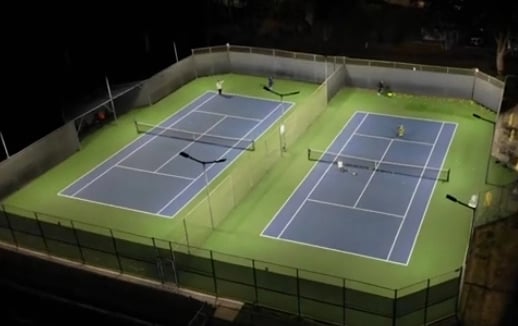
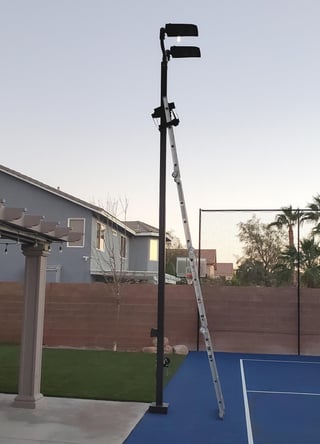
LED Tennis Court Light Actual Installation - LED Light Expert
Key Factors to Consider When Choosing LED Tennis Court Lights
Selecting the best LED tennis court lights involves more than just picking the brightest option. Various factors need to be considered to ensure optimal lighting conditions that enhance visibility, performance, and the overall playing experience. Here are the key factors to keep in mind:
Brightness and Lumens
How Many Lumens Do I Need to Light a Tennis Court?
Brightness is a critical aspect of tennis court lighting, and it is measured in lumens. Lumens indicate the amount of visible light emitted by a source. For a standard tennis court, the total lumens required can vary depending on whether the court is for recreational or professional use.
Generally, a recreational tennis court needs around 200,000 to 300,000 lumens, while a professional court may require up to 400,000 lumens to ensure adequate visibility.
Explanation of Lumens and Their Role in Lighting
Lumens measure the total quantity of visible light emitted by a source. Unlike watts, which measure energy consumption, lumens directly relate to brightness. In the context of tennis court lighting, higher lumens mean brighter illumination, which is crucial for players to see the ball and their surroundings clearly.
Recommended Lumens per Square Meter for Optimal Lighting
To achieve optimal lighting, it is recommended to have about 300-500 lumens per square meter (lux) on a tennis court. This ensures that the entire playing area is uniformly lit, minimizing shadows and dark spots that can affect gameplay.
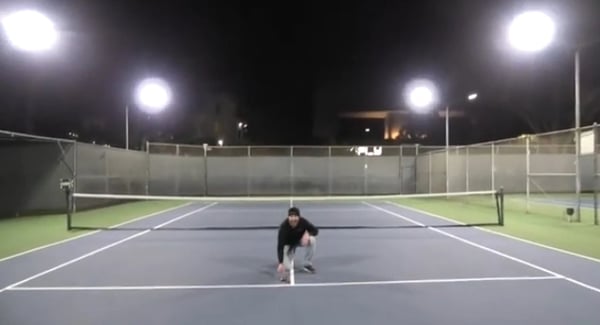
Lux Measurement - Tennis Court Lighting - LED Light Expert
Color Temperature
Importance of Choosing the Right Color Temperature
Color temperature, measured in Kelvin (K), refers to the hue of the light emitted by a source. It ranges from warm (yellowish) to cool (bluish) light. The right color temperature is essential for ensuring players can see the ball and court lines clearly without experiencing eye strain.
Ideal Color Temperature Range for Tennis Courts
For tennis courts, a color temperature between 4000K and 6000K is ideal. This range provides a neutral to cool white light, which enhances visibility and mimics natural daylight conditions. It helps players see more clearly and react more quickly to fast-moving balls.
Beam Angle and Distribution
Explanation of Beam Angle and Its Impact on Lighting Coverage
The beam angle of a light fixture determines the spread of the light emitted. A narrower beam angle focuses light on a smaller area, while a wider beam angle covers a larger area. For tennis courts, the right beam angle ensures that the entire playing surface is uniformly lit, without significant variations in brightness.
Recommended Beam Angles for Uniform Illumination
For uniform illumination, beam angles between 60° and 120° are recommended. This range provides a good balance between coverage and intensity, ensuring that the light reaches all areas of the court without creating overly bright or dark spots.
CRI (Color Rendering Index)
Importance of High CRI for Accurate Color Representation
The Color Rendering Index (CRI) measures a light source’s ability to reveal the true colors of objects compared to natural light. A high CRI is crucial for sports lighting as it ensures accurate color representation, which is important for players to distinguish the ball, lines, and other players clearly.
Recommended CRI Levels for Sports Lighting
For tennis court lighting, a CRI of 80 or higher is recommended. This level of CRI ensures that colors appear natural and vibrant, enhancing visual comfort and improving the overall playing experience.
Choosing the best LED tennis court lights involves considering these key factors to create a well-lit, visually comfortable, and safe playing environment. The right combination of brightness, color temperature, beam angle, and CRI will ensure that your tennis court is perfectly illuminated for both recreational and professional play.
In the next sections, we will delve into specific product recommendations and installation tips to help you achieve the best results.
Lighting Design Considerations for LED Tennis Court Lights
When designing the lighting for a tennis court, several factors come into play to ensure optimal illumination and compliance with standards. Here, we break down the key considerations to help you make informed decisions.
Court Size and Layout
How to Determine the Number of Lights Needed Based on Court Dimensions
The number of lights required depends on the size and layout of the tennis court. A standard tennis court measures 23.77 meters long and 8.23 meters wide for singles play, with a wider width of 10.97 meters for doubles. To ensure adequate lighting, it’s essential to calculate the total area and determine the lumen requirements based on the recommended lumens per square meter (lux).
For example, a professional court requiring 400,000 lumens will need an efficient arrangement of lights to cover the entire area uniformly. This typically involves placing multiple light fixtures around the court perimeter, ensuring that no area is left dimly lit.
Placement Strategies for Even Lighting Distribution
Strategically placing lights around the court is crucial for even distribution. Common placement strategies include positioning lights at the corners and along the sides of the court. This setup helps eliminate shadows and provides uniform lighting. Additionally, ensuring that lights are angled correctly can prevent glare and improve visibility for players.
Height of Lights for a Tennis Court
Energy Efficiency and Cost Savings
Meeting Standards and Regulations
Overview of Lighting Standards for Tennis Courts
Proper lighting for tennis courts must adhere to specific standards to ensure safety and performance. These standards are set by organizations such as the International Tennis Federation (ITF) and national sports bodies. They cover aspects like brightness, uniformity, glare control, and light pollution.
Ensuring Compliance with National and International Guidelines
Ensuring compliance with these standards is essential for both recreational and professional courts. This involves:
- Checking Local Regulations: Different regions may have specific requirements for sports lighting, including brightness levels, pole heights, and environmental considerations.
- Consulting with Experts: Working with lighting designers or consultants who understand these standards can help in creating a compliant lighting plan. You can get a free light study with the experts.
- Regular Inspections: Periodic inspections and maintenance ensure that the lighting system continues to meet regulatory requirements and provides optimal performance.
By considering these design factors and adhering to standards, you can create a well-lit tennis court that enhances player performance, safety, and overall experience. In the next section, we will explore specific product recommendations and provide practical tips for installation and maintenance.
LED Tennis Court Lights: Additional Features to Look For
When choosing LED tennis court lights, it's not just about brightness and energy efficiency. Additional features can significantly enhance the functionality, durability, and convenience of your lighting system. Here are some key features to look for:
Smart Controls and Dimming Options
Benefits of Smart Lighting Systems
Smart lighting systems offer advanced features that can greatly improve the management and efficiency of your tennis court lighting. These systems can be controlled remotely via smartphone apps or computer interfaces, providing greater flexibility and convenience.
Features Like Dimming, Remote Control, and Scheduling
- Dimming: The ability to adjust the brightness levels of your lights allows you to create the perfect lighting conditions for different times of day or specific events. Dimming can also help save energy when full brightness is not necessary.
- Remote Control: Smart lighting systems enable you to control your racquet-sport lighting from anywhere. This is particularly useful for managing multiple courts or when you need to make adjustments on the fly.
- Scheduling: Automated scheduling features allow you to set your lights to turn on and off at specific times. This ensures that your courts are always adequately lit during operational hours and helps save energy by turning off lights when they are not needed.
Weather Resistance and Durability
Importance of IP Ratings and Weatherproof Features
Outdoor lighting fixtures must withstand various weather conditions. The Ingress Protection (IP) rating of a light fixture indicates its resistance to dust and water. For court illumination fixtures, an IP rating of at least IP65 is recommended. This rating ensures that the lights are dust-tight and protected against water jets from any direction.
Choosing Lights That Can Withstand Harsh Outdoor Conditions
When selecting LED lights for outdoor tennis courts, it's essential to choose fixtures made from high-quality, weather-resistant materials. Features to look for include corrosion-resistant housings, UV-stabilized coatings, and robust seals that prevent water and dust ingress. These features ensure that the lights remain functional and maintain their performance even in harsh weather conditions such as heavy rain, strong winds, or extreme temperatures.
High Quality LED Lights and Warranty
Investing in high-quality LED lights ensures reliable performance, longevity, and reduced maintenance costs. Here are some aspects to consider:
- LED Quality: Look for lights that use high-quality LED chips from reputable manufacturers. These chips provide better brightness, color consistency, and efficiency.
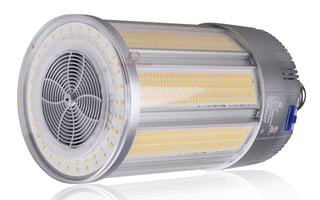
- Heat Dissipation: Efficient heat dissipation is crucial for the longevity of LED lights. Look for fixtures with good thermal management features, such as heat sinks or fans, to prevent overheating and extend the lifespan of the lights.
- Warranty: A solid warranty is a good indicator of the manufacturer's confidence in their product. Look for LED tennis lighting systems that come with a comprehensive warranty of at least 5 years. This provides peace of mind and ensures that you are covered in case of any defects or performance issues.
Common Questions and Answers
When it comes to selecting the best LED racquet-sport lighting, several common questions arise. Here, we address these questions to help you make an informed decision.
How Many Lumens Do I Need to Light a Tennis Court?
The number of lumens required to light a tennis court depends on whether it is for recreational or professional use. Generally, a recreational tennis court needs around 200,000 to 300,000 lumens, while a professional court may require up to 400,000 lumens. This ensures adequate visibility and uniform lighting across the entire court.
How Bright Should a Tennis Court Be?
The brightness of a tennis court is measured in lux, which is the number of lumens per square meter. For recreational use, a brightness level of 300 lux is usually sufficient. However, for professional play, a brightness level of 500 lux or higher is recommended to ensure optimal visibility and performance.
What is the Height of Lights for a Tennis Court?
The height at which lights are mounted significantly impacts their effectiveness. For most tennis courts, poles should typically be between 8 to 12 meters high. This height provides an even distribution of light, minimizes glare, and ensures the entire playing surface is well-lit.
What is the Best LED Tennis Court Light?
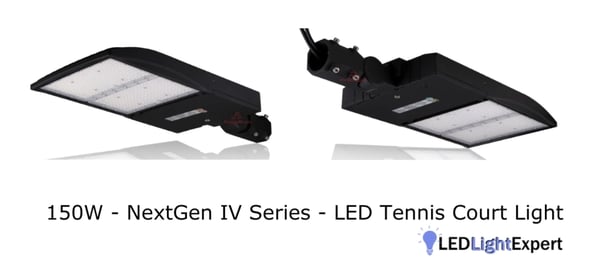
There are many excellent LED court illumination fixtures on the market, but one standout option is the NextGen IV. This light offers superior brightness, energy efficiency, and durability. It features high-quality LED chips, excellent heat dissipation, and a robust design that can withstand harsh outdoor conditions. Additionally, the NextGen IV provides customizable lighting options, including smart controls and dimming features, making it a top choice for both recreational and professional tennis courts.
Conclusion
Key Features to Compare
How to Choose the Best Tennis Court Lights: Buyer and Maintenance Checks
A good decision on tennis court lights starts with the real installation conditions, not just the product name. Check the application, mounting height, voltage, light level, glare, controls, wet or dust exposure, service access, and whether a photometric layout or qualified installer is needed before ordering.
| Check | Why it matters |
|---|---|
| Application | Confirms the fixture, lamp, control, or accessory fits the actual space and task. |
| Mounting and wiring | Prevents fit, voltage, access, and safety problems during installation. |
| Controls and maintenance | Protects energy savings, usability, troubleshooting, and long-term performance. |
Frequently Asked Questions
- How many lumens do I need to light a tennis court?
- A recreational tennis court typically needs 200,000 to 300,000 lumens, while a professional court may require up to 400,000 lumens. The recommended brightness is 300 to 500 lumens per square meter (lux) across the playing surface for uniform visibility.
- What is the best height for tennis court lights?
- Tennis court light poles should typically be 8 to 12 meters high. This height provides even distribution of light across the court while minimizing glare and ensuring the entire playing surface is well-lit without harsh shadows.
- What color temperature is best for tennis court lighting?
- A color temperature between 4000K and 6000K is ideal for tennis courts. This range provides a neutral to cool white light that enhances visibility, mimics natural daylight conditions, and helps players see the ball clearly and react quickly.
- What CRI level is recommended for sports lighting?
- A CRI of 80 or higher is recommended for tennis court lighting. The Color Rendering Index measures how accurately a light source reveals the true colors of objects compared to natural light, helping players clearly distinguish the ball, court lines, and other players.
- What beam angle should I use for tennis court lights?
- Beam angles between 60 and 120 degrees are recommended for uniform illumination on a tennis court. This range provides a good balance between coverage and intensity, ensuring light reaches all areas without creating overly bright or dark spots.
- What IP rating do outdoor tennis court lights need?
- An IP rating of at least IP65 is recommended for outdoor tennis court lights. This rating ensures the fixtures are dust-tight and protected against water jets from any direction, with corrosion-resistant housings and UV-stabilized coatings for harsh weather conditions.
- How bright should a tennis court be for professional play?
- For professional play, a brightness level of 500 lux or higher is recommended to ensure optimal visibility and performance. Recreational courts typically need around 300 lux. Lighting must also comply with standards set by the International Tennis Federation and national sports bodies.
- How much energy do LED tennis court lights save compared to traditional lights?
- LED tennis court lights consume significantly less power than traditional options. For example, an LED producing the same lumen output as a 1000-watt traditional light may only use 400 watts. Combined with lifespans up to 100,000 hours and lower maintenance costs, the return on investment is substantial.
Related Articles
Ready to Upgrade Your Lighting?
Our LED lighting experts are here to help you find the perfect solution for your space.

Dara Greaney is founder and CEO of LED Light Expert with deep expertise in LED fixtures and light design.
Editing by David Peguero.

Trusted by Thousands
Our customers love us — and we love them back.


-
 Free Shipping
On orders over $49.00
-
 Free Extended Warranty
Up to 7 Years Free Warranty On LED Lights
-
100% Satisfaction Guarantee
