


Posted by Dara Greaney on 10/30/2025 to
LED Stadium Lights
Quick AnswerSoccer field pole height depends on field size and competition level: 30–40 ft for small recreational fields, 40–60 ft for amateur or training fields, and 70–100+ ft for professional stadiums. Taller poles spread light more evenly, reduce glare, and support televised play. Always pair pole height with the correct beam angle and validate the layout with a photometric study before installation.
Lighting design for soccer fields is about more than just brightness. The height of each light pole plays a direct role in how evenly the field is lit, how well players see the ball in motion, and how comfortable the experience is for both players and spectators. The right pole height ensures visibility, reduces glare, and improves overall safety. Poorly planned installations can leave dark spots, cause shadows, or create blinding glare that distracts players and officials during fast-paced play.
Light pole height also affects how the entire lighting system performs over time. The higher the poles, the wider the light coverage, but if placed too high or low, visibility and balance suffer. Finding the right height requires a balance between illumination levels, beam angles, and mounting configurations. This is where soccer LED lights show their advantage, offering precise control, efficient output, and long-lasting reliability.
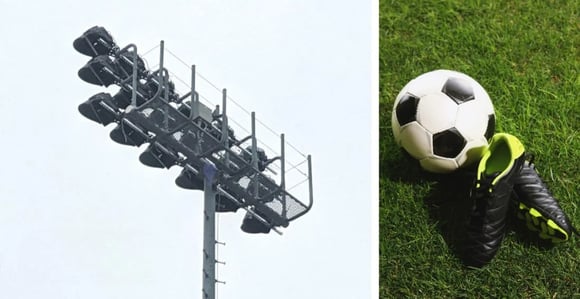
The right pole height ensures visibility, reduces glare, and improves overall safety.
Why Light Pole Height Matters in Soccer Field Lighting
Light pole height determines how evenly light spreads across a soccer field. With LED lights for soccer field installations, height directly influences how fixtures distribute illumination and prevent overlighting or underlighting specific areas.
Light Distribution and Uniform Coverage
Higher poles spread light across a broader area, reducing hot spots or dark zones. Lower poles may provide intense illumination in one area but create uneven brightness across the field. The correct mounting height ensures consistent lux levels from one goal to the other, critical for professional-level play and televised matches.
Shadow Control and Glare Reduction
Proper pole height helps control shadows caused by players, the ball, or nearby structures. Lights mounted too low can cast distracting shadows and create harsh glare. Taller poles, paired with correctly angled LED soccer field lighting, minimize glare and distribute light more naturally. This helps players keep focus on the ball without squinting or being blinded by fixture beams.
Ball Visibility During Fast-Paced Play
Soccer is a high-speed sport. The ball can move from one end of the field to the other in seconds. Poor lighting makes tracking it difficult, especially during night games or under uneven illumination. Well-positioned poles at the right height allow soccer LED light systems to cover the entire playing area evenly, so players can accurately judge distance, direction, and speed.
Spectator Comfort and Broadcast Quality
Good lighting enhances the viewing experience. Spectators need to follow the action comfortably, and broadcasters rely on balanced lighting for high-quality visuals. Pole height affects how cameras capture color and motion, and how evenly the light reflects across the turf. Well-designed setups use taller poles to reduce glare in camera lenses and to give the field a professional, visually appealing appearance.
The Relationship Between Pole Height, Luminaire Angle, and Beam Type
Light pole height, luminaire angle, and beam angles work together to define how effectively a field is lit. The taller the pole, the narrower the beam angle required for even coverage. A lower pole may use a wider beam but risks glare and light spill.
Using adjustable-mount fixtures helps fine-tune these variables. Modern LED lights for soccer field systems allow engineers to match beam types and luminaire angles with specific pole heights, ensuring balanced lighting that meets safety and performance standards.
In short, pole height isn’t just a structural detail. It’s one of the most important factors in creating professional-grade LED soccer field lighting that supports visibility, safety, and the overall experience for everyone on and off the field.
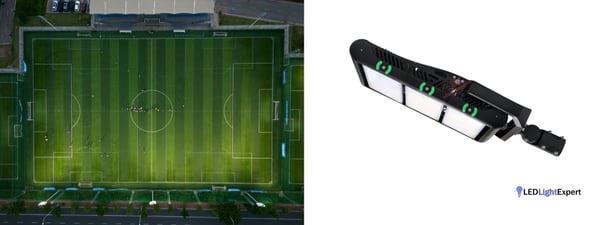
105,000 Lumen LED Sport and Area Lights -Icon Pro III Series- 750 Watt LED Sport and Area Light
Standard Soccer Field Lighting Requirements
Lighting design for soccer fields follows defined standards from organizations such as FIFA, the NCAA, and the Illuminating Engineering Society (IES). These standards exist to create consistent lighting that supports safety, visibility, and fair play. They outline the proper light levels (measured in lux or foot-candles) and the uniformity ratios needed for even light distribution across the field.
- For recreational and training fields, lighting should range between 75 and 150 lux, or roughly 7 to 14 foot-candles. This level provides enough brightness for practice sessions and local games without wasting energy.
- Amateur and club matches typically require 200 to 300 lux, or around 19 to 28 foot-candles, which helps players see the ball clearly and maintain awareness during competitive play.
- Professional competitions demand much stronger lighting, usually between 500 and 1000 lux, or 46 to 93 foot-candles, to meet broadcasting requirements and provide clear visibility for players, referees, and cameras.
Uniformity is another critical factor. The IES defines this through ratios known as U1 and U2 uniformity ratios. In common sports-lighting usage, U1 and U2 compare minimum illuminance against maximum and average values, helping designers control dark spots and hot spots. For professional LED soccer field lighting, the target is a U1 ratio below 2.0 and a U2 ratio near 1.5.
Maintaining these ratios prevents glare, harsh shadows, and dark spots that can make it harder for players to track the ball or for referees to make accurate calls. Uniform lighting also ensures smoother, high-quality visuals for spectators and broadcast cameras.

These standards exist to create consistent lighting that supports safety, visibility, and fair play.
Recommended Pole Heights for Soccer Fields
Selecting the right pole height is one of the most important steps in designing soccer LED light systems. The pole height affects light spread, intensity, and glare control, all of which influence how the game is played and viewed.
Small Recreational Fields: 30–40 Feet (9–12 Meters)
For local or community fields, shorter poles between 30 and 40 feet provide sufficient coverage. These setups are practical, affordable, and work well with wide-beam LED lights for soccer field installations. They create consistent brightness across smaller areas without overlighting and make maintenance easier for facilities with limited budgets.
Amateur or Training Fields: 40–60 Feet (12–18 Meters)
Amateur and training fields benefit from poles in the 40 to 60-foot range. This height improves light uniformity and reduces glare while providing more consistent visibility during extended training sessions or evening matches. Fixtures at this level can be angled strategically to achieve even coverage across the entire field, minimizing light spill into nearby areas.
Professional or Stadium Fields: 70–100+ Feet (21–30+ Meters)
Professional and stadium-level installations require taller poles—typically 70 to 100 feet or higher—to meet strict lighting standards. These setups often use narrow-beam LED soccer field lighting fixtures that project light long distances while keeping brightness balanced and reducing glare for players, spectators, and broadcast cameras. Taller poles also allow for more precise aiming, which is essential in televised environments where color accuracy and visual consistency matter.
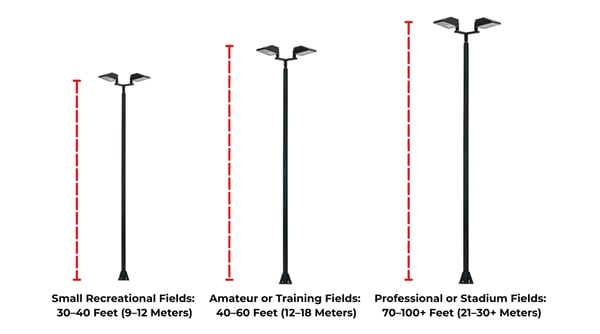
Selecting the right pole height is one of the most important steps in designing soccer LED light systems
Factors Affecting Pole Height Selection
Field Size
Field dimensions directly affect required pole height. Smaller youth fields can use shorter poles because the light doesn’t need to travel as far. Regulation fields, around 100–110 meters long and 64–75 meters wide, need taller poles and higher-output fixtures to maintain uniform brightness across the larger playing surface.
Number of Poles
The number of poles around the field influences how evenly the light spreads. Four-pole systems are suitable for small or recreational fields, but they can leave dim corners. Six-pole systems offer better light balance for club or training fields, while eight-pole setups are standard for professional fields where uniform coverage and glare control are essential.
Fixture Wattage and Beam Angle
The power and beam angle of each fixture must match the pole height. High-wattage fixtures with narrow beams perform best on tall poles, providing focused light over long distances. Shorter poles should use wider beam angles to cover more ground with fewer shadows. Matching these variables correctly ensures consistent light levels from goal to goal.
Example Layout Concept
A well-designed lighting system places poles evenly around the perimeter of the soccer field, with fixtures aimed slightly downward to minimize glare and prevent light spill beyond the play area. Engineers typically use photometric modeling to calculate precise mounting heights and aiming angles before installation.
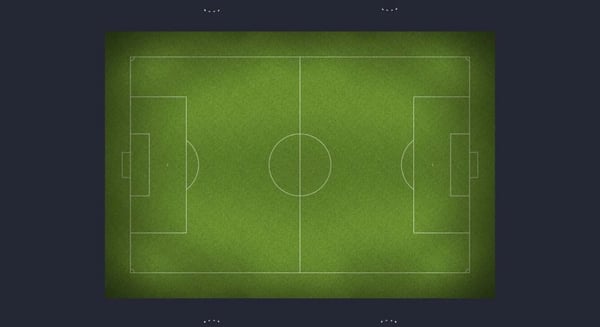
LED Soccer Field Render - Photometric Light Study Example
By carefully balancing pole height, beam type, and fixture placement, lighting designers can create LED lights for soccer field systems that meet official standards, improve visibility, and provide safe, enjoyable environments for players and fans alike.
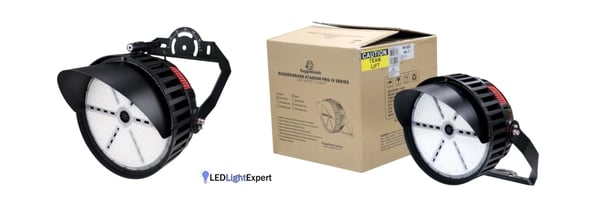
500 Watt - StadiumPro IV Series LED Stadium Lights.
Key Factors in Selecting the Right Pole Height
Choosing the correct pole height for LED soccer field lighting depends on several interrelated factors. The goal is to balance light performance, energy efficiency, and long-term safety while maintaining compliance with lighting standards.
Field Size and Layout
The size and layout of the soccer field directly affect the required pole height. Larger regulation fields need taller poles to provide wide, even light distribution. Smaller recreational or youth fields can use shorter poles since the light doesn’t need to cover as much ground.
For full-size fields, taller poles prevent uneven lighting and help fixtures reach deeper parts of the playing area without creating harsh contrasts.
Lighting Type and Beam Angle
The type of lighting used, and specifically the beam angle of each fixture, determines how high the poles should be. Narrow-beam fixtures project light farther and are best suited for taller poles, making them ideal for stadiums or professional fields.
Wide-beam fixtures spread light more broadly and are typically mounted on shorter poles to create even coverage without over-concentration. Modern soccer LED light systems often feature adjustable mounts, allowing fine-tuning of beam angles to achieve perfect illumination across every zone.
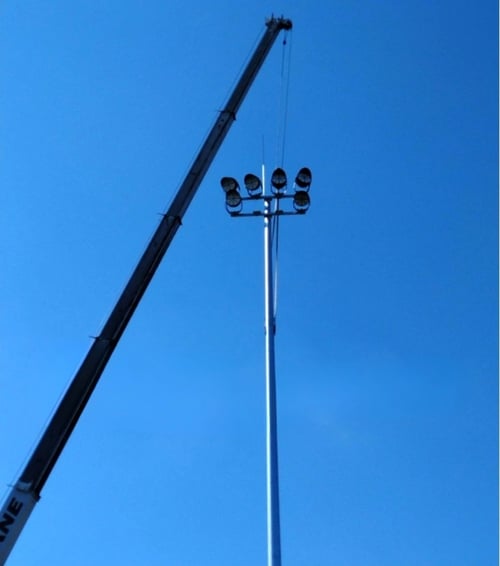
70 Foot Light Pole - Sports Light Pole or High Mast Pole - Soccer or Football Field Ready
Mounting Configuration
How fixtures are mounted on each pole plays a significant role in lighting performance. Single or double fixtures per pole are common for smaller fields, while cluster mounts or crossarms are used in larger facilities.
These configurations allow designers to position multiple lights at different angles from a single pole, improving coverage and reducing shadows. The more complex the mounting setup, the taller and stronger the pole structure needs to be to support both weight and wind load.
Purpose of the Field
The intended use of the field also affects height requirements. Recreational fields can prioritize practicality and cost-efficiency, while training fields may focus on uniform brightness for consistent player visibility. Competitive and broadcast fields require taller poles to accommodate higher lighting standards and more precise aiming.
In televised events, lighting must eliminate dark spots and produce balanced color rendering for cameras, which means pole height and fixture placement are carefully engineered for professional presentation.
Environmental Conditions
Environmental factors influence both the design and placement of poles. Areas with strong winds, heavy rain, or frequent storms require reinforced poles with proper wind-load ratings. Local regulations may limit pole height to reduce light pollution or preserve community aesthetics.
Surrounding structures such as trees or nearby buildings can also obstruct light paths, requiring adjustments in height and aiming. These environmental considerations ensure long-term stability, durability, and compliance with safety codes.
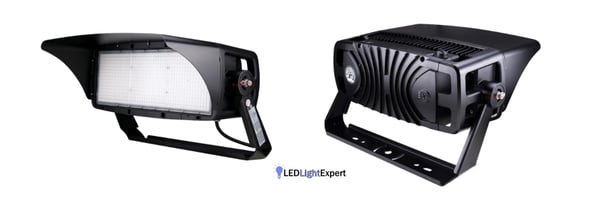
600W - Centario Pro Series LED Stadium Lights - 87,000 Lumens - 5000K
Common Mistakes to Avoid
Even small errors in pole height selection can lead to significant performance issues. Avoiding these mistakes helps protect both the investment and the quality of play on the field.
Installing Poles Too Low
Mounting poles too low can cause uneven lighting, harsh glare, and distracting shadows. This makes it harder for players to track the ball and can create safety concerns. Taller poles distribute light more evenly and reduce glare by keeping fixtures above players’ direct line of sight.
Over-Lighting Areas
More light isn’t always better. Over-lighting can lead to glare, eye strain, and wasted energy. The goal of LED sports lights for soccer field design is efficiency — using the right number of fixtures at the correct height to achieve target brightness without unnecessary light output.
Ignoring Local Environmental Restrictions
Each location has unique zoning and environmental guidelines that affect how lighting systems can be installed. Ignoring local codes or aesthetic requirements can lead to costly redesigns or community complaints. Always confirm height limits and environmental impact standards before installation.
Not Planning for Future Upgrades
Many facilities fail to consider how lighting needs might change over time. Poles that are too short or undersized can limit future fixture upgrades. Planning for scalable pole heights and mounts ensures the lighting system remains adaptable as technology advances or competition levels increase.
Skipping Photometric Studies
Skipping the photometric design phase is one of the most common mistakes in field lighting. A professional photometric light study models the entire field to show brightness levels, beam spread, and potential glare zones before installation.
These studies help determine the ideal pole height, placement, and fixture type for each project.
To see examples of how these simulations improve performance, visit LED Light Expert’s Soccer Field Photometric Studies.
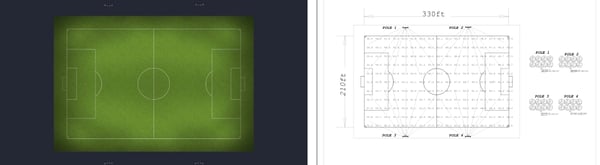
LED Soccer Field Lights - Photometric Study Example
Conclusion
Pole height is more than a structural choice — it’s a key factor that defines how a soccer field performs under lights. Proper height selection improves visibility, minimizes glare, enhances safety, and ensures compliance with lighting standards. From community fields to professional arenas, the best results come from aligning pole height with field size, fixture type, and environmental conditions.
LED soccer field lighting provides the flexibility and precision needed to achieve that balance. By pairing the right pole height with photometric planning and high-quality fixtures, designers can create lighting systems that make every game clearer, safer, and more enjoyable for players and spectators alike.
Soccer Field Light Height: Buyer and Maintenance Checks
A good soccer field light height decision starts with the real installation conditions, not just the product name. Check the application, mounting height, voltage, light level, glare, controls, wet or dust exposure, service access, and whether a photometric layout or qualified installer is needed before ordering.
| Check | Why it matters |
|---|---|
| Application | Confirms the fixture, lamp, control, or accessory fits the actual space and task. |
| Mounting and wiring | Prevents fit, voltage, access, and safety problems during installation. |
| Controls and maintenance | Protects energy savings, usability, troubleshooting, and long-term performance. |
Frequently Asked Questions
What is the recommended light pole height for a soccer field?
Recommended pole height varies by field type: 30–40 ft (9–12 m) for small recreational fields, 40–60 ft (12–18 m) for amateur and training fields, and 70–100+ ft (21–30+ m) for professional or stadium fields. Taller poles provide wider coverage and reduce glare, but must be matched with the correct fixture beam angle to maintain uniform lux levels and meet IES RP-6 and FIFA standards.
What lux level is required for soccer field lighting?
Recreational and training fields need roughly 75–150 lux (7–14 foot-candles). Amateur and club matches require 200–300 lux (19–28 foot-candles). Professional and broadcast-quality competition demands 500–1,000 lux (46–93 foot-candles). These values come from IES, FIFA, and NCAA guidance and assume acceptable uniformity ratios (U1 below 2.0, U2 near 1.5).
How many light poles does a soccer field need?
Four-pole systems are typical for small or recreational fields but can leave dim corners. Six-pole layouts are standard for club and training fields and provide better balance. Eight-pole configurations are used on professional fields where uniform coverage and glare control are essential for televised play. The exact count should always be validated by a photometric study.
How does pole height affect glare and uniformity on a soccer field?
Taller poles keep luminaires above players' and spectators' direct line of sight, which cuts glare and softens shadow edges. Taller mounting also allows narrower beam angles aimed downward, producing a more uniform distribution across the playing surface. Short poles tend to create hot spots, long shadows, and harsher glare into cameras and spectators.
What beam angle should I use with a tall soccer field pole?
Taller poles (70 ft and up) should use narrow-beam optics — typically NEMA Type 2 to Type 4 / roughly 10°–30° — to project focused light over longer throw distances while controlling spill. Mid-height poles (40–60 ft) pair well with medium beam angles around 40°–60° Shorter recreational poles under 40 ft benefit from wide beams in the 60°–90° range to cover ground with fewer hot spots.
Do I need a photometric study before installing soccer field lights?
Yes. A photometric study models the entire field before installation and confirms footcandle levels, uniformity ratios, glare, and light trespass beyond the property line. Skipping the study is the most common and costly mistake in sports lighting projects — fixing under-lit or non-uniform fields after the poles are set is expensive and sometimes structurally impossible.
Frequently Asked Questions
- What is the recommended light pole height for a soccer field?
- Recommended pole height varies by field type: 30–40 ft (9–12 m) for small recreational fields, 40–60 ft (12–18 m) for amateur and training fields, and 70–100+ ft (21–30+ m) for professional or stadium fields. Taller poles provide wider coverage and reduce glare, but must be matched with the correct fixture beam angle to maintain uniform lux levels and meet IES RP-6 and FIFA standards.
- What lux level is required for soccer field lighting?
- Recreational and training fields need roughly 75–150 lux (7–14 foot-candles). Amateur and club matches require 200–300 lux (19–28 foot-candles). Professional and broadcast-quality competition demands 500–1,000 lux (46–93 foot-candles). These values come from IES, FIFA, and NCAA guidance and assume acceptable uniformity ratios (U1 below 2.0, U2 near 1.5).
- How many light poles does a soccer field need?
- Four-pole systems are typical for small or recreational fields but can leave dim corners. Six-pole layouts are standard for club and training fields and provide better balance. Eight-pole configurations are used on professional fields where uniform coverage and glare control are essential for televised play. The exact count should always be validated by a photometric study.
- How does pole height affect glare and uniformity on a soccer field?
- Taller poles keep luminaires above players' and spectators' direct line of sight, which cuts glare and softens shadow edges. Taller mounting also allows narrower beam angles aimed downward, producing a more uniform distribution across the playing surface. Short poles tend to create hot spots, long shadows, and harsher glare into cameras and spectators.
- What beam angle should I use with a tall soccer field pole?
- Taller poles (70 ft and up) should use narrow-beam optics — typically NEMA Type 2 to Type 4 / roughly 10°–30° — to project focused light over longer throw distances while controlling spill. Mid-height poles (40–60 ft) pair well with medium beam angles around 40°–60°. Shorter recreational poles under 40 ft benefit from wide beams in the 60°–90° range to cover ground with fewer hot spots.
- Do I need a photometric study before installing soccer field lights?
- Yes. A photometric study models the entire field before installation and confirms footcandle levels, uniformity ratios, glare, and light trespass beyond the property line. Skipping the study is the most common and costly mistake in sports lighting projects — fixing under-lit or non-uniform fields after the poles are set is expensive and sometimes structurally impossible.
Related Articles

Pole Mount Lighting LED Lighting Guide outdoor lighting often includes the installation of a light pole and how to mount the lights.
Why Choose LED Court Lights Over Metal Halide LED Lighting Guide Why Choose LED Court Lights Over Metal Halide. Expert guide from LED Light Expert.
Best LED Parking Lot Lights LED Lighting Guide Best LED Parking Lot Lights. What makes an LED parking lot light great and what to look for.
Ready to Upgrade Your Lighting?
Our LED lighting experts are here to help you find the perfect solution for your space.
Call Us Today
Email Us
Hours
Monday–Friday 8am–5pm PST
Monday-Friday, 8am-5pm PST

About the Author
Dara Greaney is founder and CEO of LED Light Expert with deep expertise in LED fixtures and light design.
Editing by David Peguero.

Call us Toll Free at 800-674-9420 for the Best in Lighting Design & Assistance. Please use Ext 1 for sales or lighting design help. Para Espanol Extension 7. For Hours & More Click Here- Contact
Trusted by Thousands
Our customers love us — and we love them back.


-
 Free Shipping
On orders over $49.00
-
 Free Extended Warranty
Up to 7 Years Free Warranty On LED Lights
-
100% Satisfaction Guarantee
