

Quick Answer
CRI tells you how accurately a light source renders colors; color temperature tells you whether the white light looks warm, neutral, or cool. A high-CRI LED can be 3000K, 4000K, or 5000K. For most commercial spaces, choose the Kelvin that fits the task and use 80+ CRI as a baseline; choose 90+ CRI when color judgment matters.
LED Color Spectrum and Color Rendering Index (CRI)
LED color quality has two parts that shoppers often mix together: the color of the white light and the way that light renders objects. Color temperature, measured in Kelvin, tells you whether a lamp looks warm, neutral, or cool. Color Rendering Index, usually called CRI, tells you how naturally colors appear under that lamp compared with a reference light source.
Both matter. A warehouse may need crisp 5000K light for visibility and productivity. A restaurant may need warmer 3000K light so food and skin tones look comfortable. A retail store, paint shop, kitchen, studio, or medical space may need higher CRI so reds, blues, wood tones, wiring colors, and labels are easier to judge.
What CRI Means
CRI is a 0 to 100 scale. A higher number generally means the source renders colors more accurately. Many general-purpose commercial LEDs are 80+ CRI, which is adequate for warehouses, parking garages, and basic utility lighting. Choose 90+ CRI when color detail matters, such as retail displays, salons, galleries, kitchens, inspection benches, and medical or dental environments.
CRI is useful, but it is not perfect. It compresses color quality into one number, so it can miss important hue shifts. That is why professional lighting specifications may also reference ANSI/IES TM-30, an Illuminating Engineering Society method that evaluates fidelity, gamut, and hue-specific color changes with more detail than CRI alone.
Color Temperature: 3000K, 4000K, and 5000K
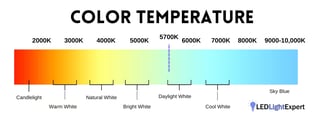
Color temperature does not measure accuracy; it measures appearance. 3000K looks warm and slightly amber. 4000K looks neutral white. 5000K looks cool white or daylight. Outdoor security, warehouse, and sports lighting often use 5000K because it feels bright and crisp. Offices and schools often use 4000K. Hospitality and residential spaces usually feel better at 2700K to 3500K.
We generally avoid recommending very cool light above 5000K unless there is a specific industrial or specialty reason. Cooler light can increase glare and visual harshness if the fixture optics are poor. The better answer is usually proper fixture placement, beam angle, glare control, and enough lumens at the right color temperature.
Color Spectrum vs. CRI
The visible color spectrum describes the wavelengths a light source emits. CRI describes how those wavelengths affect the appearance of real objects. Two LEDs can have the same Kelvin rating and very different color rendering if their spectral output is different.
For most commercial and home applications, you do not need a full-spectrum lamp. You need the right Kelvin, enough lumens, proper optical control, and an appropriate CRI for the task. Full-spectrum language matters more in specialty applications such as horticulture, photography, museum work, and color-critical inspection.
How to Choose
- Warehouses, parking lots, and utility areas: 4000K to 5000K, usually 70 to 80+ CRI.
- Offices, schools, and retail basics: 3500K to 5000K, usually 80+ CRI.
- Retail displays, kitchens, salons, galleries, and inspection: 3000K to 5000K depending on the room, usually 90+ CRI.
- Outdoor security and sports: 4000K to 5000K with glare control, uniformity, and proper aiming as the priority.
Key Features to Compare
CRI, Spectrum, and CCT Work Together
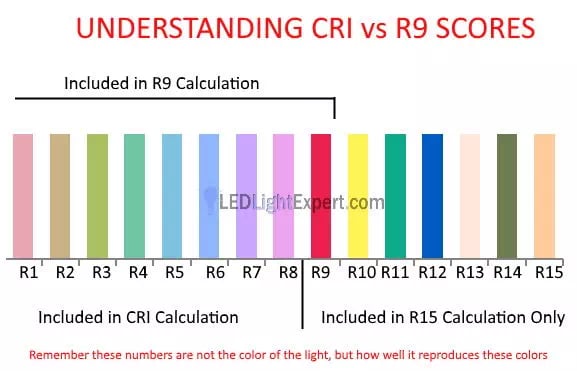
CRI measures how accurately a light source renders a set of test colors compared with a reference source. It is useful, but it is not the whole story. CCT describes whether light appears warm, neutral, or cool. Spectrum describes the distribution of wavelengths. R9 and other saturated color values can matter when reds, skin tones, food, wood, fabric, or merchandise need to look right.
| Application | Color-quality priority |
|---|---|
| Retail and showrooms | High CRI, good R9, controlled glare, and product-appropriate CCT. |
| Warehouses and shops | Enough CRI for labels and tasks, with CCT selected for comfort and visibility. |
| Sports and courts | Uniform light, glare control, flicker performance, and color rendering for players and cameras. |
| Outdoor security | Visibility, contrast, responsible CCT, distribution, and spill control. |
More Details to Consider
All You Need to Know Color Spectrum of LED and the Color Rendering Index (CRI). CRI is defined as how a light source makes the color of an object appear to human eyes and how well subtle variations in color shades are revealed. It's really how well a light bulb shows true colors. The Color Rendering Index (CRI) is a scale from 0 to 100. It indicates how accurate a given light source is when it comes to rendering color when compared to a reference light source.
The higher the CRI, the better the color rendering ability. Color temperature or Kelvin of light. Before we learn about the color spectrum of lights, we should know about the color temperature. LED color temperature measures the color of a LED light bulb. It defines the amount of pure white, yellow, red and blue color in a light. Another way to think of the color temperature is how 'warm' or 'cool' is the white LED light bulb.
Color temperature is measured in degrees Kelvin and is a measure of the part of the color spectrum that is found in light. There is no right or wrong in Kelvin; it's a personal choice. Typically warmer 3000K is used in homes, 4000K in offices and larger areas, and 5000K in warehouses and outdoors. We no longer recommend going above 5000K for most spaces. The American Medical Association has cautioned against blue-rich outdoor lighting because of glare and its potential to disrupt sleep cycles. The light emitted by the sun includes a wide range of colors.
While the sunlight appears white to us, this sunlight when viewed through a prism creates a spectrum of colors including violet, blue, green, yellow, orange and red. Those are listed by wavelength from short to longest. These colors merge to create the white light that is visible to us. The sun also includes invisible light from ultraviolet radiation. Light bulbs create colors in different ways; most of them use a combination of the 6 colors to create the light. Most create the light with a few and then may add diffusers of other colors.
Wide spectrum lights are really only important for grow lights and even then you typically need a few different ones to create the full spectrum. The importance of CRI can be established from the fact that it makes the color appear more natural. The CRI makes it easier for your eyes to see these colors. It also helps identify the different colors at depth which improves depth perception. Higher CRI in your home LED Downlights generally means more enjoyable light. Good CRI in LED floodlights is still important.
CRI Ranges Each type of bulb has a different range. The incandescent bulbs have a 98+ score. High-pressure sodium bulbs have the lowest range, at only about 20. The metal halide bulbs have a score of approximately 60. Older LEDs had a score of about 50. The modern LED Corn Bulbs, however, are best in this regard as well. Today, the LEDs have a score ranging from 80 to 90 and more making them a great LED replacement for 400 watt Metal Halide.
CRI is a vast term but focuses on the color rendition. CRI is the measure of the ability of a light source to accurately render all frequencies of its color spectrum when compared to a perfect reference light of a similar type. Color Spectrum focuses on the wavelength of light and is less important for home or commercial lighting. In choosing LED lighting, having the full color spectrum is not as important as a good CRI and a Kelvin level that you enjoy.
LEDs are the most advanced form of a light bulb. They are capable of producing more lumens of light, and they are available in different temperatures. Today they have strong CRI scores and an ever improving color spectrum.
Frequently Asked Questions
- What is CRI in LED lighting?
- CRI, or Color Rendering Index, estimates how accurately a light source renders colors compared with a reference source. The scale runs to 100, and higher values generally mean colors look more natural. Many commercial LEDs are 80+ CRI; retail, medical, art, and inspection spaces often use 90+ CRI.
- Is CRI the same thing as color temperature?
- No. Color temperature, measured in Kelvin, describes whether white light looks warm, neutral, or cool. CRI describes color accuracy. A 3000K and a 5000K LED can both have high CRI, but the room will feel very different because the white point is different.
- What CRI should I choose for LED lights?
- For warehouses, parking lots, and general commercial spaces, 70 to 80+ CRI is often acceptable. For offices, retail, kitchens, studios, medical spaces, and anywhere color judgment matters, 90+ CRI is usually worth considering. Always balance CRI with lumens, efficacy, glare control, and the application.
- What is TM-30 and how is it different from CRI?
- ANSI/IES TM-30 is a newer color rendition method from the Illuminating Engineering Society. It evaluates fidelity, gamut, and hue-specific shifts using more color samples than CRI. CRI is still common on product pages, but TM-30 gives specifiers a fuller picture when color quality is critical.
Related Articles


Ready to Upgrade Your Lighting?
Our LED lighting experts are here to help you find the perfect solution for your space.

Dara Greaney is founder and CEO of LED Light Expert with deep expertise in LED fixtures and light design.
Editing by David Peguero.
Tagged Products


Trusted by Thousands
Our customers love us — and we love them back.


-
 Free Shipping
On orders over $49.00
-
 Free Extended Warranty
Up to 7 Years Free Warranty On LED Lights
-
100% Satisfaction Guarantee
